
Santa Ines Sheep: Characteristics, Adaptability and Management
April 6, 2026
Nubian Goat (Anglo-Nubian): Milk, Meat and Characteristics
April 6, 2026The Boer goat is the world’s most widely recognized and commercially important meat goat breed. Developed in South Africa over more than a century of selection, the Boer combines outstanding muscular development, rapid growth, adaptability to diverse environments and high carcass quality — making it the benchmark against which all other meat goat breeds are measured.
In this guide we cover the Boer goat’s origin, physical characteristics, productive performance, crossbreeding advantages and key management practices for maximizing results on your farm.
Origin and History
The Boer goat was developed in South Africa in the early 20th century, primarily by Dutch (Boer) settlers in the Eastern Cape region. The word “Boer” means “farmer” in Afrikaans. The breed was created through selective crosses between indigenous African goats, European dairy breeds and some Asian breeds (possibly Angora).
The South African Boer Goat Breeders’ Association was established in 1959, and formal breed standards were developed. The Boer was first exported to the United States and other countries in the early 1990s and rapidly gained popularity worldwide.
Today, Boer genetics are found in commercial goat operations on every continent.
Physical Characteristics
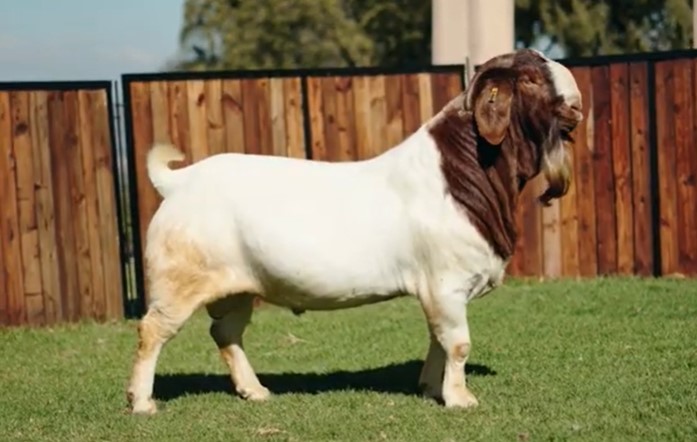
The Boer is a large, muscular goat with a distinctive appearance. Key physical traits:
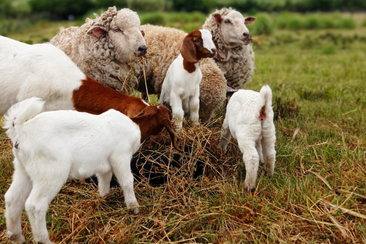
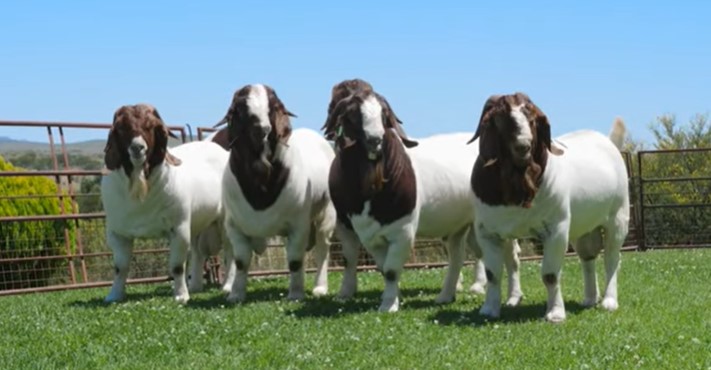
- Color: White body with a red-brown (bay) head and neck, though fully white (Kalahari Red) and fully brown varieties exist. A blaze (white stripe) on the face is common.
- Head: Convex (Roman) nose profile, broad forehead
- Ears: Long, wide, pendulous — a distinctive breed characteristic
- Horns: Both sexes are horned — horns curve backward and outward
- Body: Deep, wide chest; broad, well-muscled back; short, strong legs
- Skin: Loose skin with good pigmentation — provides sun protection
- Adult buck weight: 110–160 kg
- Adult doe weight: 80–110 kg
Productive Performance
The Boer’s production figures are among the best in the world for a meat goat:
- Average daily gain (kids): 200–300 g/day under good nutrition; exceptional individuals can reach 400 g/day
- Weaning weight (90 days): 20–28 kg
- Slaughter weight: Kids reach 30–40 kg at 4–6 months
- Dressing percentage: 48–54%
- Carcass conformation: Excellent — high proportion of high-value cuts (leg, loin, shoulder)
- Meat quality: Fine-grained, lean, tender, with excellent flavor
Reproductive Characteristics
The Boer shows good reproductive performance, though not exceptional compared to some local breeds:
- Kidding rate: 150–200% (twins are common)
- Seasonality: In temperate climates, Boer does have a defined breeding season (fall). In tropical/subtropical regions they can breed year-round.
- Puberty: Does reach puberty at 6–10 months; bucks at 5–7 months
- Milking ability: Does produce enough milk for twins, but are not high milk producers — supplemental feeding of kids may be needed in triplet litters
- Maternal behavior: Generally good, though occasional does reject one of multiple kids
Boer in Crossbreeding Programs
The Boer’s greatest commercial impact is as a terminal sire in crossbreeding programs. When Boer bucks are bred to does of local or dairy breeds, the crossbred kids show:
- Significantly higher growth rates than purebred local breeds
- Better carcass muscling and dressing percentages
- Retention of the maternal breed’s adaptability and reproductive efficiency
Common and productive Boer crosses:
- Boer x Anglo-Nubian: Combines growth with some milk production — popular in multi-purpose systems
- Boer x Spanish: Heavily used in the United States — adds muscle to the hardy, adaptable Spanish goat
- Boer x Saanen: Large-framed commercial cross common in Brazil and Argentina
- Boer x Kiko: Combines parasite resistance (Kiko) with superior muscling (Boer)
- Boer x Moxoto / SRD: Common in Northeast Brazil for improving local goat production
Adaptability and Environmental Tolerance
The Boer is remarkably adaptable. It performs well in:
- Semi-arid zones (South Africa, northern Mexico, Texas, Northeast Brazil)
- Tropical and subtropical regions (Brazil, Colombia, Venezuela)
- Temperate regions (USA, New Zealand, Australia, Europe)
Its pigmented skin provides protection against solar radiation, and its loose skin helps with thermoregulation. However, it is not exceptionally resistant to internal parasites — in high-parasite environments, crossbreeding with resistant breeds (Kiko, Red Maasai) or maintaining strict FAMACHA monitoring is essential.
Nutrition and Feeding
The Boer’s fast growth potential can only be realized with adequate nutrition:
- Pasture: Requires good-quality pasture or browse — Boer goats are browsers and do well in systems with diverse vegetation including shrubs and trees
- Kids in finishing: Supplement with 300–500 g/day of concentrate (16–18% crude protein) to maximize growth rate
- Gestating does: Increase energy and protein in the last 6 weeks before kidding to prevent pregnancy toxemia and ensure good colostrum production
- Minerals: Copper requirement is higher in goats than sheep — use goat-specific mineral mixes
- Water: Ensure clean water is available at all times — water restriction immediately reduces growth
Common Health Issues in Boer Goats
- Haemonchosis: Haemonchus contortus is the number one cause of death in Boer goats in warm climates. Implement FAMACHA and avoid over-reliance on anthelmintics.
- CAE (Caprine Arthritis and Encephalitis): Important viral disease — test and cull positive animals, implement strict biosecurity for new introductions
- Caseous lymphadenitis (CLA): Corynebacterium pseudotuberculosis — causes abscesses in lymph nodes. Cull affected animals; vaccination available in some countries.
- Enterotoxemia: Especially in kids on high grain diets. Vaccinate regularly.
- Foot problems: Footrot and foot scald — manage through foot bathing, nutrition (adequate zinc) and culling of chronic cases
Maintaining individual health records for each Boer goat in OvinApp allows you to track FAMACHA scores, treatments, growth data and reproductive performance — and make evidence-based management decisions to keep your herd productive and healthy.