

Boer Goat: Characteristics, Meat Production and Management
April 6, 2026
Hampshire Down Sheep: Characteristics and Meat Production
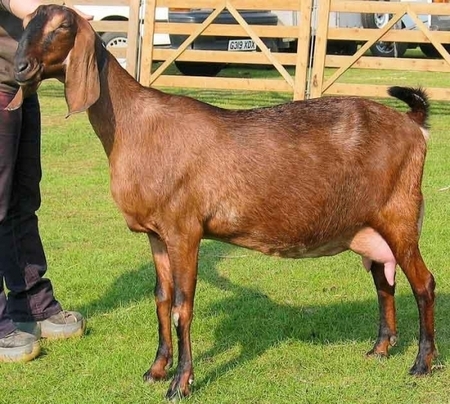
April 6, 2026The Anglo-Nubian goat (known simply as Nubian in the United States) is one of the world’s most popular dual-purpose goat breeds. Recognized by its distinctive long, pendulous ears and convex “Roman” nose profile, the Anglo-Nubian is valued for producing high butterfat milk and showing good meat conformation — making it suitable for both dairy and meat production systems.
In this guide we cover the Anglo-Nubian’s origin, physical characteristics, milk and meat production performance, and key management recommendations.
Origin and History
The Anglo-Nubian was developed in England in the 19th century by crossing local British goats with imported breeds from North Africa, the Middle East and India. The contributing breeds included the Nubian (from the Nile region), the Zaraibi (Egyptian), the Jamnapari (Indian) and others.
The breed was formally established in the UK in the late 1800s and arrived in the United States in the early 20th century, where it became the most numerous registered dairy goat breed. In the US, the breed is called simply “Nubian” rather than Anglo-Nubian.
Today the breed is found worldwide, with significant populations in the UK, USA, Brazil, Australia, New Zealand, South Africa and throughout Latin America.
Physical Characteristics
The Anglo-Nubian is instantly recognizable by several distinctive features:
- Ears: Long, wide and pendulous — the most distinctive breed characteristic. Ears hang close to the head and extend at least 2.5 cm below the muzzle.
- Profile: Strongly convex (Roman) nose — visible from a distance
- Size: One of the largest dairy goat breeds — adult does weigh 55–80 kg; bucks 80–120 kg
- Coat: Short and fine, in a wide variety of colors and patterns (solid, spotted, blotched)
- Horns: Both sexes can be horned, but most animals in registered herds are disbudded
- Udder: Well-developed, round, with good attachment and medium-sized teats
Milk Production: The High Butterfat Advantage
The Anglo-Nubian’s milk is its most celebrated characteristic. While it does not produce the highest volumes of milk among dairy breeds (Saanen and Alpine outperform it in volume), its milk has exceptionally high butterfat and protein content:
- Annual milk production: 600–900 liters per lactation (commercial herds)
- Butterfat content: 4.5–5.5% (vs. 3.5–4.0% for Saanen/Alpine)
- Protein content: 3.5–4.0%
- Lactation length: 280–305 days
The high butterfat content makes Anglo-Nubian milk ideal for:
- Cheese production — higher cheese yield per liter due to more fat and protein
- Artisan dairy products — butter, dulce de leche (caramel), ice cream
- Direct consumption — richer, creamier flavor than lower-fat milks
Meat Production
The Anglo-Nubian is a true dual-purpose breed. Its body is larger and more muscular than other dairy goat breeds, which gives it good meat conformation:
- Kids growth rate: 150–250 g/day with good nutrition
- Slaughter weight: 25–35 kg at 4–5 months
- Dressing percentage: 45–50%
- Use of surplus males: Male kids that are not needed for breeding can be raised for meat, generating an additional revenue stream alongside milk production
While the Boer goat outperforms the Nubian in pure meat production, the Anglo-Nubian offers the advantage of generating income from both milk and meat in a single operation, which is particularly valuable for small and medium-scale producers.
Reproductive Characteristics
- Breeding season: In temperate regions, Anglo-Nubians are seasonal breeders (fall). In tropical regions they can breed year-round.
- Kidding rate: 150–200% — twins are common; triplets occur
- Puberty: Does can reach puberty as early as 5 months, but first mating should be at 7–10 months or 40 kg minimum body weight
- Maternal instinct: Generally good
- Long-season breeding: Compared to European breeds, Anglo-Nubians tend to have a longer breeding season due to their subtropical ancestry — an advantage for year-round milk production

Adaptability
The Anglo-Nubian’s subtropical heritage gives it better heat and humidity tolerance than purely European breeds like Saanen or Alpine. It performs well in:
- Tropical and subtropical regions (Brazil, Colombia, Venezuela, Africa, India)
- Semi-arid zones with access to water and shade
- Temperate zones (UK, USA, New Zealand, Australia)
However, it is more susceptible to internal parasites than adapted local breeds, and requires careful parasite monitoring especially in warm, humid climates.
Management Recommendations
Housing
- Provide dry, well-ventilated housing — goats are highly susceptible to respiratory problems from damp conditions
- Elevated slatted floors help reduce contact with feces and internal parasite larvae
- Ensure adequate shade in hot climates to maintain production levels
Nutrition for Milk Production
- Balance ration for energy and protein according to production level — milking does require significantly more than maintenance
- Provide high-quality hay or pasture plus concentrate supplementation during lactation
- Calcium and phosphorus balance is critical for milk production — supplement with limestone and dicalcium phosphate as needed
- Provide goat-specific mineral mix (copper levels appropriate for goats, not the same as sheep)
Milking Management
- Milk twice daily at consistent times for maximum production
- Practice pre-milking teat dipping and post-milking teat dipping to prevent mastitis
- Monitor somatic cell count (SCC) — elevated SCC indicates subclinical mastitis
- Dry off does 60 days before the expected kidding date
Managing milk records, reproduction data, health events and growth of kids in OvinApp gives you the information you need to optimize your Anglo-Nubian herd’s performance and maximize returns from both milk and meat production.