


Katahdin Sheep: Characteristics, Origin and Meat Production
April 5, 2026
10 Best Hair Sheep Breeds for Meat Production
April 5, 2026The Suffolk sheep is one of the most widespread and productive meat breeds in the world. Its distinctive black head, athletic build and exceptional growth rate make it a top choice for commercial lamb producers on every continent.
In this guide you will find everything you need to know about the Suffolk breed: its origin, physical characteristics, productive performance and the key management practices to get the best out of it on your farm.
Origin and History of the Suffolk Breed
The Suffolk originated in England, specifically in the county of Suffolk in East Anglia. It was developed in the late 18th and early 19th centuries by crossing Southdown rams with Norfolk Horned ewes. The result was a breed that combined the exceptional muscle conformation of the Southdown with the hardiness and foraging ability of the Norfolk.
The breed was officially recognized in 1810, and by the late 19th century it had spread to the United States, Australia, New Zealand and South Africa — countries where it remains highly popular today.
Physical Characteristics
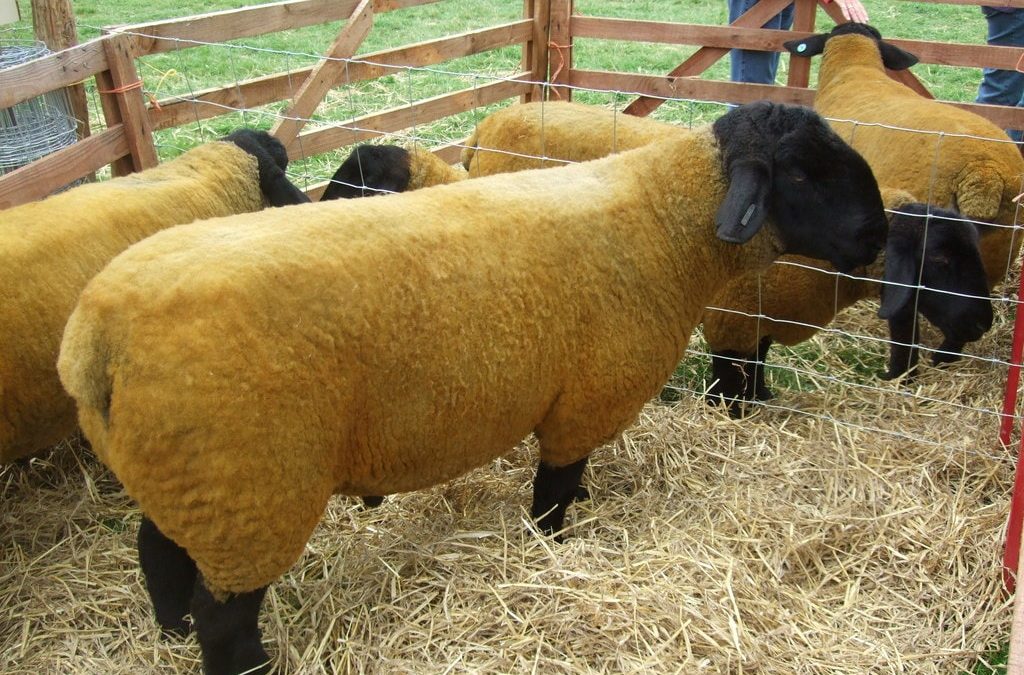
The Suffolk is immediately recognizable by its black, wool-free head and legs. This contrasts sharply with the white fleece covering its body. Key physical traits include:
- Face: Black, long and slightly Roman-nosed, with no wool on the head
- Ears: Black, medium-length, and slightly drooping
- Body: Deep, wide and well-muscled, with a level back
- Legs: Black, strong and well-spaced — good for extensive grazing
- Fleece: White, medium-length, 25–33 microns
- Horns: Polled (both males and females)
Adult rams weigh between 113 and 160 kg, while ewes range from 80 to 115 kg. Suffolk lambs are born vigorous and grow rapidly.
Meat Production Performance
The Suffolk is first and foremost a meat breed. Its performance in feedlots and pasture-based systems is outstanding:
- Average daily gain: 300–400 g/day under good nutrition
- Slaughter weight: Lambs reach 38–45 kg at 4–5 months
- Dressing percentage: 50–54%
- Muscle conformation: Excellent — high proportion of high-value cuts (leg, loin, rack)
- Meat quality: Fine-grained, well-muscled, with appropriate fat cover
Suffolk rams are widely used as terminal sires — that is, they are crossed with ewes of other breeds specifically to produce slaughter lambs. Their genetic potential for growth and muscle is transmitted very effectively to crossbred offspring.
Reproductive Characteristics
Suffolk ewes are good mothers with adequate milk production. Key reproductive data:
- Prolificacy: 150–180% (many twin births)
- Puberty: Ewes reach sexual maturity at 6–8 months
- Breeding season: Typically autumn — shorter photoperiod triggers estrus
- Gestation: 145–150 days
- Lamb vigor: Lambs are very lively at birth, start nursing quickly
In accelerated lambing systems, Suffolk ewes can lamb 3 times in 2 years, boosting overall productivity per ewe per year.
Adaptability and Management
The Suffolk adapts well to temperate and semi-arid climates. It performs best in regions with cold winters and mild summers, but has also shown good results in subtropical areas when properly managed.
Key management considerations:
- Nutrition: Demands good-quality pasture or supplemental feed, especially for lambs in finishing
- Shearing: Once or twice a year depending on climate and fleece length
- Parasite control: Like most wool breeds, susceptible to internal parasites — FAMACHA monitoring and strategic drenching are essential
- Hoof care: Regular trimming recommended, especially in wet conditions
- Housing: Can be raised extensively on pasture; shelter during lambing improves lamb survival
Suffolk as a Terminal Sire: Crossbreeding Advantages
One of the greatest commercial advantages of the Suffolk is its role as a terminal sire in crossbreeding programs. When Suffolk rams are bred to Merino, Corriedale or other maternal breeds, the resulting crossbred lambs exhibit:
- Superior growth rates compared to purebred maternal breeds
- Excellent muscle development in leg and loin
- Good feed conversion efficiency
- Higher carcass value at market
This is why Suffolk genetics are found in commercial sheep flocks in Australia, New Zealand, Chile, Uruguay and the United States, used as the “meat finishing” component in three-breed crossing systems.
Common Health Issues
Suffolk sheep are generally hardy, but like all breeds they are susceptible to certain health problems:
- Scrapie: Suffolk has a higher genetic susceptibility to scrapie than some other breeds. Selecting for resistant genotypes (ARR/ARR) is recommended in regions where this prion disease is present.
- Internal parasites: Haemonchus contortus and other strongyles are significant threats, especially in warm, humid climates
- Footrot: Caused by Dichelobacter nodosus — managed through foot bathing, vaccination and culling of chronically affected animals
- Selenium deficiency: White muscle disease in lambs can occur in selenium-deficient soils — supplement ewes pre-lambing
- Pneumonia: Fast-growing lambs in confined conditions are susceptible — ensure adequate ventilation
Is the Suffolk Right for Your Operation?
The Suffolk is an excellent choice if you are looking for:
- A breed with outstanding growth rates and carcass quality
- A terminal sire to improve meat production in a crossbreeding system
- A well-documented breed with global support, genetics and data
- A breed that performs well in both feedlot and pasture-based systems
It may not be the best option for very hot, humid climates where hair breeds like Dorper or Katahdin perform better with lower management inputs. But in temperate zones or as a crossbreeding sire, the Suffolk is hard to beat.
Managing a flock with OvinApp allows you to track individual animal weights, health events, breeding records and production data — essential for maximizing the performance of high-potential breeds like the Suffolk.