

Nubian Goat (Anglo-Nubian): Milk, Meat and Characteristics
April 6, 2026
What Do Sheep and Goats Eat? Complete Feeding Guide
April 6, 2026The Hampshire Down sheep (commonly known simply as Hampshire) is one of the oldest and most prestigious meat sheep breeds in the world. Originating in southern England, it has spread to every sheep-producing continent and remains one of the most important breeds for commercial lamb production due to its outstanding muscle conformation, rapid growth and adaptability.
In this guide we cover the Hampshire Down’s origin, physical characteristics, productive performance and key management recommendations.
Origin and History
The Hampshire Down was developed in Hampshire County, England, in the early 19th century. It was created through crosses between Southdown rams (the preeminent meat breed of the time) and native Hampshire ewes, which were larger but less refined in conformation.
The resulting breed combined the Southdown’s compact, well-muscled build with a larger frame, producing a breed that could reach heavier slaughter weights while maintaining excellent carcass quality. The Hampshire was officially registered as a breed in 1861.
The breed was exported to the United States in the mid-19th century and rapidly became one of the most popular breeds for lamb production. Today it is found throughout North America, South America, Australia, New Zealand and Europe.
Physical Characteristics
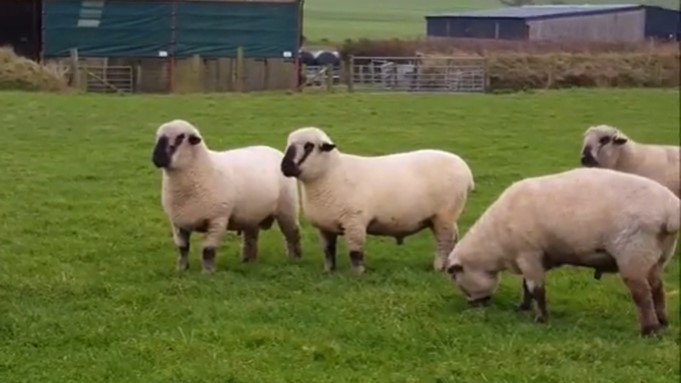
The Hampshire Down is a large, muscular breed with distinctive coloring. Key physical traits:
- Face and legs: Dark brown to black — similar to Suffolk but with a broader, heavier head
- Wool: White, covering the body but not the head or legs; medium wool, 25–33 microns
- Head: Broad, with a slight depression between the eyes — heavier and more massive than the Suffolk
- Ears: Dark, medium-length, carried horizontally
- Body: Deep, wide chest; well-arched ribs; strong, level back; broad, heavily muscled loin and rump
- Horns: Polled (both sexes)
- Adult ram weight: 110–150 kg
- Adult ewe weight: 70–100 kg
The Hampshire is slightly larger and heavier-boned than the Suffolk, with a more massive head. Both breeds are often confused by newcomers, but the Hampshire has a heavier build and broader face.
Meat Production Performance
The Hampshire Down is first and foremost a meat breed with outstanding performance characteristics:
- Average daily gain: 280–380 g/day under good nutrition
- Slaughter weight: Lambs reach 38–48 kg at 4–5 months
- Dressing percentage: 50–55%
- Muscle conformation: Exceptional — one of the best-muscled breeds, with a very high proportion of the leg and loin (highest-value cuts)
- Carcass quality: Firm, fine-grained meat with appropriate fat cover
Hampshire lambs are known for laying down muscle before fat, which means they can be taken to relatively heavier weights without excessive fat deposition — an advantage in markets that prefer lean carcasses.
Reproductive Characteristics
- Prolificacy: 140–175% — twins relatively common
- Puberty: Ewes reach puberty at 7–9 months
- Breeding season: Autumn in temperate climates — triggered by decreasing day length
- Gestation: 147–150 days
- Maternal ability: Good — ewes are attentive mothers with adequate milk production for twins
- Lamb vigor: Lambs are born large and vigorous, begin nursing quickly
Hampshire as Terminal Sire
Like the Suffolk, the Hampshire Down is widely used as a terminal sire in commercial crossbreeding programs. Hampshire rams crossed with Merino, Corriedale, or other maternal breed ewes produce crossbred lambs with:
- Superior growth rates to purebred maternal breeds
- Excellent leg and loin muscle development
- Good feed conversion efficiency in feedlot systems
- Heavier carcasses at the same age compared to maternal breed lambs
In some regions, Hampshire and Suffolk are used alternately or in combination in three-breed crossing programs, where a maternal breed ewe is bred to a Hampshire or Suffolk terminal sire.
Hampshire vs. Suffolk: Which to Choose?
Both are excellent terminal sire breeds, but there are some practical differences:
- Frame size: Hampshire is slightly larger and heavier-boned — better for producing heavier carcasses; Suffolk is slightly lighter and often considered more “refined”
- Parasite resistance: Hampshire shows higher genetic susceptibility to scrapie (similar to Suffolk) — select for resistant genotypes in areas where scrapie is present
- Availability of genetics: Suffolk is more widely distributed globally; Hampshire is common in North America and South America but less available in some regions
- Market fit: In markets demanding lamb carcasses over 20 kg, Hampshire often has an advantage due to its larger frame
Management Recommendations
Nutrition
- Hampshire rams and ewes have high nutritional requirements relative to smaller breeds — ensure pasture quality and quantity are adequate
- Supplement finishing lambs with 200–400 g/day of concentrate to achieve growth targets
- Flush ewes 2–3 weeks before the breeding season to increase ovulation rate
- Supplement ewes in late gestation with additional energy and protein to prevent pregnancy toxemia and ensure colostrum production
Health Management
- Clostridial vaccination: Vaccinate ewes pre-lambing and lambs at 6–8 weeks against Clostridium perfringens and tetanus
- Internal parasites: Hampshire is susceptible to gastrointestinal nematodes — implement FAMACHA monitoring and targeted selective treatment
- Footrot: Large, heavy breeds are particularly prone to foot problems — regular foot bathing and inspection
- Scrapie genetics: Test rams for scrapie genotype (ARR/ARR preferred) before use as terminal sires
Shearing
Hampshire Down fleeces produce medium-grade wool that can generate supplemental income but is not the primary product. Shear once or twice a year depending on your climate and management system.
Recording individual weights, health treatments, breeding data and growth performance for your Hampshire flock in OvinApp makes it much easier to evaluate genetic progress, manage health protocols and make informed culling and selection decisions over time.