


Oxford Down Sheep: Origin, Characteristics, Weight and Meat
November 1, 2026Ovine and caprine fasciolosis: the liver fluke and the saguaypé
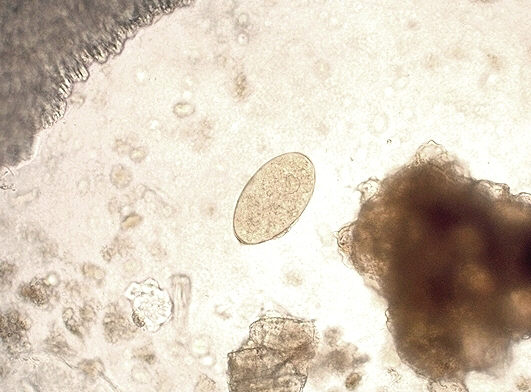
CDC / Dr. Mae Melvin, 1979 — PHIL 1540. Public domain. Source / Fuente / Fonte
Fasciolosis is a parasitic disease of the liver caused by Fasciola hepatica, known in Uruguay as saguaypé and as the liver fluke. Its cycle depends on water, snails and pasture. In sheep and goats it can be acute, during the migration of the immature forms, or chronic, due to the adults in the bile ducts. No single sign confirms the disease. MSD Veterinary Manual
What fasciolosis is and why it matters
F. hepatica is one of the most important trematodes of domestic ruminants and has a wide range of hosts, including humans. It is described in cattle, sheep, alpacas and llamas. The chronic form is more common in cattle and rarely fatal; the acute and subacute forms are more frequent in sheep and camelids, and often fatal. MSD
Goats share pastures and may be exposed to the same metacercariae, but the severity, the tests and the registered products must not be copied from another species. The decision is a veterinary one. MSD
The cycle: lymnaeid snail, water and pasture
The adults live in the bile ducts and shed eggs with the feces. The eggs hatch only in water; at 22–26 °C, the miracidia develop in 9 to 10 days, and below 10 °C development is scanty. The miracidia live about three hours and must infect lymnaeid snails; in Uruguay, Plan Agropecuario mentions Lymnaea viatrix. MSD Plan Agropecuario
In the snail the parasite multiplies and produces cercariae, which emerge after about 6 to 7 weeks and encyst on aquatic vegetation or pasture near water. This is how the metacercariae form; they survive for many months if they do not dry out and persist in damp hay for weeks or months, depending on temperature and humidity. MSD
The young forms cross the intestinal wall, pass into the peritoneum and travel through the liver parenchyma for 6 to 8 weeks before settling in the bile ducts. Egg shedding usually begins at 2 or 3 months. MSD
Acute, subacute and chronic forms
The acute form appears 2 to 6 weeks after ingesting a large number of metacercariae. The immature forms destroy liver tissue and cause hemorrhage and anemia; in sheep, a distended and painful abdomen, anemia and sudden death are described. The subacute form, with sustained intake, can cause death from hemorrhage and anemia. MSD
The chronic form is due to the adults in the bile ducts and causes anemia, loss of condition, submandibular edema or bottle jaw and lower milk production. In sheep it can be fatal and liver damage accumulates. It can go unnoticed. In goats, the same signs require confirmation with tests. MSD Plan Agropecuario
Anemia, bottle jaw and FAMACHA: signs that are not enough
Anemia and bottle jaw, or bottle-shaped edema, are compatible signs, but not specific ones. They can also appear in other diseases, so the cause should be investigated with the veterinarian. Plan Agropecuario describes them in chronic and acute cases, without confirming the cause. MSD Plan Agropecuario
FAMACHA is an anemia screening tool based on the color of the ocular conjunctiva. It does not identify F. hepatica or any causal agent, it does not measure parasite burden and it does not replace laboratory testing. A favorable value does not rule out the disease and an unfavorable one does not confirm it. University of Rhode Island, limits of FAMACHA
Diagnosis: sedimentation does not answer everything
Fecal sedimentation is simple and inexpensive, but it only detects patent infections, when there are already adults shedding eggs. In the acute phase there are no eggs because the immature forms have not yet reached the bile ducts; a negative result does not rule out the early or acute phase. Shedding varies from one day to the next, so samples are sometimes repeated. MSD
When sedimentation is not enough, the veterinarian can choose other tests according to the phase, the country and the actual availability at the laboratory. MSD mentions antibody ELISA in some countries, which detects infection before the patent period, but does not report the burden and may remain positive after the parasite is eliminated. It also mentions coproantigen ELISA, whose reliability in the field is questioned; necropsy is diagnostic. MSD
The availability and usefulness of each test vary with the context. The choice and interpretation are up to the veterinarian. MSD
Control: reduce exposure
Control combines treating infected animals, reducing exposure to snails and keeping livestock out of infested pastures. MSD A central measure is grazing management: identify low, waterlogged paddocks or those with edges along watercourses and keep livestock from grazing there during the periods of highest risk. Setting aside dry areas helps. MSD Plan Agropecuario
This article does not recommend draining wetlands or applying molluscicides. Those interventions have their own impacts and regulations; MSD notes that molluscicides are banned in most countries because of their negative effect on the environment. The priority is to reduce exposure, not to eliminate the wetland. MSD
Treatment: a veterinary decision
Fasciolicides are not equivalent: their efficacy varies with the phase of the parasite, and many act little on the immature forms that cause acute damage. MSD The veterinarian must choose the product and the timing according to the phase, the species, the registration for that species in the country, the withdrawal periods and local resistance. Not all are approved in all countries or for all species; registration for goats must be verified. MSD
Timing depends on local epidemiology, rainfall, temperature and grazing management. Dates from other regions do not automatically transfer to the southern hemisphere. MSD
Resistance and treatment failure
Resistance to fasciolicides has been demonstrated for several compounds, which complicates programs based on treatment alone. MSD A poor result is not always resistance: it may be due to a wrong diagnosis, an uncovered phase, incorrect administration, an expired or poorly applied product, reinfection or inadequate management. Local resistance must be verified, not presumed.
Before blindly switching products, it is worth checking efficacy with an appropriate test and timing, under veterinary judgment. Rotation without diagnosis or monitoring is not a sufficient strategy. MSD
Meat and milk withdrawal periods
Withdrawal periods vary with the product, the species and the legislation. MSD notes that many fasciolicides have long withdrawal periods before slaughter and before the milk is used for human consumption. MSD The label and the country’s regulations are the reference; the withdrawal period of another species must not be extrapolated.
Zoonosis
F. hepatica has a wide range of hosts, including humans. MSD Human fasciolosis is a zoonosis and requires prevention measures suited to the exposure. Prevention relies on managing water, food and the environment. It should not cause alarm, but neither should it be minimized: the risk depends on exposure and on timely diagnosis.
November in Uruguay: context, not a forecast
In the southern hemisphere, November is spring. A Plan Agropecuario document, prepared in a context of water deficit, indicates that Uruguayan epidemiological studies observed the highest number of infected animals and the highest number of parasites in late spring and early summer. Plan Agropecuario That record provides context on seasonal risk, but it is not current 2026 data, it is not a national forecast and it does not justify scheduling treatments by calendar.
The same document warns that drought changes grazing habits and can lead animals to low, wet areas, which favors the ingestion of infective forms. Plan Agropecuario A drought does not eliminate the risk: it can concentrate grazing where snails and metacercariae persist. Nor should a November calendar from Ireland be transferred to the southern hemisphere.
Frequently asked questions
Is fasciolosis detected with a fecal test?
It can be detected when there is a patent infection, because sedimentation looks for eggs. In the acute or early phase it may be negative; a negative result does not rule out the disease. MSD
Does FAMACHA tell whether there is liver fluke?
No. FAMACHA gives guidance on anemia, but it does not identify the agent or replace laboratory testing. University of Rhode Island
Does drought eliminate the risk?
Not necessarily. Grazing can concentrate in low, wet areas, and the infective forms can persist. Plan Agropecuario
Conclusion
Ovine and caprine fasciolosis is not diagnosed only by anemia, bottle jaw or FAMACHA; sedimentation is useful in patent infections, but a negative result does not close the case. Control requires grazing management and reduced exposure, without draining wetlands or using molluscicides as advice. Treatment must be indicated by a veterinarian, with a product registered for that species and country, verified withdrawal periods and an assessment of efficacy. In Uruguay, the seasonal record and drought are context, not an automatic rule. MSD Plan Agropecuario