

Flushing ewes: what it is, when to do it and how to apply the technique
October 27, 2026
Basic Veterinary First Aid Kit for Sheep and Goats: What to Include and How to Use It
October 27, 2026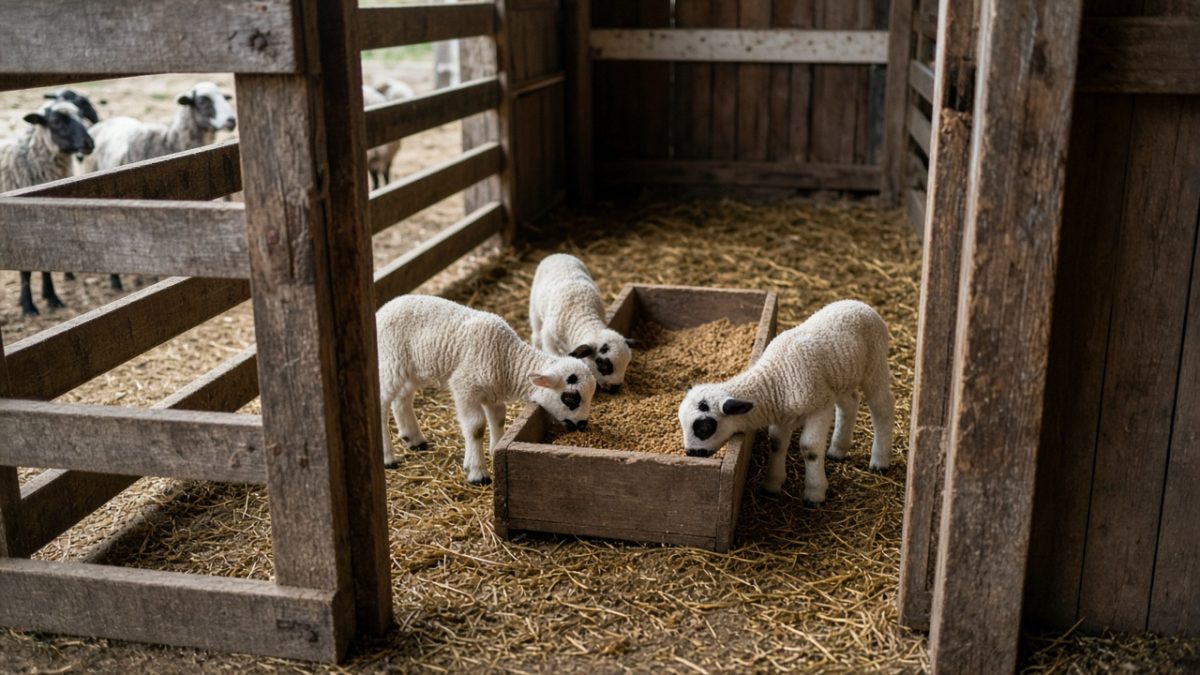
The first months of a lamb’s life are the time of greatest feed conversion efficiency of its entire life. Taking advantage of that stage can make a difference in weaning weight, in the age at sale and in the pressure the ewe goes through during lactation. One of the most widely used tools to achieve this is creep feeding, or differential feeding of lambs alongside their mothers.
In this article we explain what creep feeding is, how to build a lamb creep feeder, which feed to use and when it makes sense.
What is creep feeding?
Creep feeding is a system that allows lambs to access supplemental feed while staying with their mothers, without the ewes being able to eat it. It is done with a pen or area with openings that lambs can pass through but ewes cannot.
The term comes from the lambs “creeping” through the opening. There is also a variant called creep grazing, in which instead of a concentrate, lambs are given access to better-quality pasture ahead of their mothers.
Benefits of creep feeding
- Higher weight gain in lambs, especially twins and lambs from ewes with little milk.
- Early rumen development: eating solid feed stimulates the growth of the rumen papillae.
- Easier weaning: lambs already know how to eat, so they suffer less from the change.
- The chance to sell earlier or reach slaughter weight sooner.
- Less pressure on the ewe during lactation, which helps her recover body condition.
When to start
Lambs begin to show interest in solid feed from 2 to 3 weeks of age. Ideally the feeder is available from that moment, even if intake is very low at first. Consumption increases as they grow and continues until weaning.
Creep feeding makes the most sense when the ewes’ milk production or the pasture is not enough to cover the lambs’ growth potential: winter lambing, flocks with many twins, early lamb finishing systems, or times of low forage availability.
How to build a lamb creep feeder
Location
Place it where ewes spend a lot of time: near water, shade or resting areas. If lambs do not move away from their mothers, they will not use a distant feeder. It should be dry, protected from the wind and well lit.
Openings
The entrance must let lambs through but not ewes. Openings are usually between 20 and 25 cm wide, adjustable as lambs grow and according to breed size. The most practical option is adjustable bars.
Feeders and water
Use raised or protected feeders to keep lambs from climbing in and soiling them with feces, a common source of coccidiosis. Make sure clean water is available nearby.
What feed should you use?
The feed should be palatable, high quality and high in protein, since young lambs have high requirements to grow. The most common options are:
- Commercial lamb rations (starters), usually pelleted.
- Mixes of cracked or whole grains (for example corn, oats or barley) with a protein source such as soybean or sunflower meal.
- Good-quality alfalfa hay as a complement.
Many extension guides recommend rations with around 16 to 20% crude protein at this stage. It is essential that the ration contains adequate minerals and, for males, a proper calcium-to-phosphorus ratio to prevent urinary stones. Ask your advisor for the most suitable formulation.
A tip that is often recommended: at first, offer a small amount and replace it every day so it is always fresh. Some producers place a little feed in the area where the mothers pass so the lambs discover it.
Health precautions
- Clostridial vaccination: lambs eating concentrates have a higher risk of enterotoxemia. Coordinate the vaccination plan for ewes (before lambing) and lambs with your veterinarian.
- Coccidiosis: keep feeders clean and avoid fecal contamination.
- Urinary stones in males: take care with mineral balance and access to water.
- Gradual changes: do not make abrupt changes to the ration.
Is it profitable?
It depends on the relationship between feed cost and lamb price, on feed conversion efficiency and on pasture availability. In general, feed conversion is better the younger the lambs are, so creep feeding is usually more efficient than supplementing after weaning. But the only way to know whether it pays off in your case is to measure: weigh the lambs and keep records of the feed consumed.
Record weights and gains with OvinApp
To evaluate creep feeding you need to know how much your lambs weigh and how much they gain. With OvinApp, the free app for managing sheep and goats, you can record each animal’s weights on your phone, follow their progress and compare groups to decide whether the supplementation is paying off.
Conclusion
Creep feeding is a simple tool to take advantage of the lamb’s most efficient stage, improve weaning weight and ease the load on the ewe. Done well, with a well-placed feeder, quality feed and a proper health plan, it can improve your system’s results. As always, consult your veterinarian or technical advisor to adjust the ration and the health plan to your flock.
Sources
- Sheep 101 / University of Maryland Extension (S. Schoenian). Creep feeding lambs. https://www.sheep101.info/
- INTA. Publications on lamb finishing and supplementation. https://www.argentina.gob.ar/inta
- Secretariado Uruguayo de la Lana (SUL). Technical material on lamb production. https://www.sul.org.uy/
- FAO. Resources on small ruminant production. https://www.fao.org/