

Basic Veterinary First Aid Kit for Sheep and Goats: What to Include and How to Use It
October 27, 2026
Constipation in lambs and sheep: causes, signs and what to do
October 27, 2026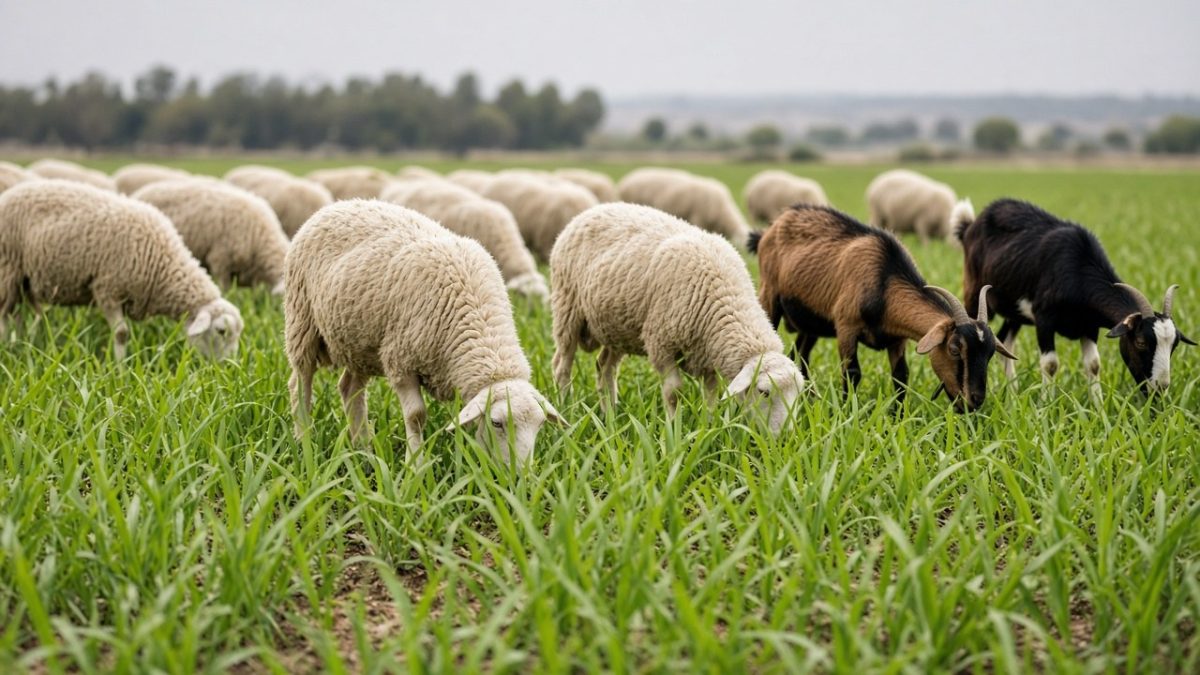
After a drought, a frost or a heavy fertilization, a green and tempting forage crop can turn into a serious problem. Nitrate and nitrite poisoning is a cause of sudden death in sheep and goats that can be prevented, but that, once it appears, progresses within hours. Knowing how to recognize it and act fast is key.
In this article we explain what it is, which plants and situations cause it, what the symptoms are, what to do if you suspect it and how to prevent it on your farm.
What is nitrate and nitrite poisoning?
Nitrates are compounds that plants absorb from the soil and use to grow. Under normal conditions they do no harm, but some plants accumulate them in excess. When the animal eats that forage, rumen microorganisms turn nitrate into nitrite, which is the real toxin. If nitrite is produced faster than the rumen can break it down, it passes into the blood and converts hemoglobin into methemoglobin, a form that cannot carry oxygen. The animal literally suffocates even though it is breathing.
When and why do plants accumulate nitrates?
Accumulation usually appears when the plant is stressed or growing very fast with plenty of nitrogen available. The most common situations are:
- Droughts followed by rain, and frosts or long cloudy spells that slow down photosynthesis.
- Excessive or recent nitrogen fertilization, including manure and slurry.
- Herbicides (such as hormone-type products like 2,4-D) applied shortly before grazing, which can also make some weeds more palatable.
- Tender regrowth and winter or summer forage crops (oats, ryegrass, wheat, sorghum, sudangrass, corn).
- Accumulator weeds such as pigweed (Amaranthus), lamb’s quarters (Chenopodium) and purslane (Portulaca oleracea), linked to several outbreaks in sheep and goats in northeastern Brazil.
Nitrate concentrates mostly in the base of the stem and does not disappear when making hay, so a bale from a stressed crop can also be dangerous. Water from wells or tanks contaminated with fertilizer is another source of risk.
Factors that increase risk in the animal
- Hungry animals that enter a green paddock suddenly and eat a lot in a short time.
- Low-energy diets or no adaptation to the new forage.
- Sudden feed changes or weakened animals.
Symptoms: how to recognize the poisoning
Signs appear quickly, a few hours after eating (between 1 and 6 hours according to the sources consulted), and sometimes only dead animals are found with no symptoms seen beforehand. The most characteristic signs are:
- Restlessness, weakness and staggering.
- Rapid, forced and noisy breathing, with the neck stretched out and the mouth open.
- Bluish, grayish or brown mucous membranes (eyes, gums, vulva).
- Fast heart rate, tremors, salivation and sometimes bloat.
- Frequent urination, diarrhea or abdominal pain.
- Collapse, convulsions and death.
A very characteristic finding appears when examining a dead animal: the blood is dark brown or chocolate-colored and clots poorly. Pregnant females that survive may abort days or weeks later because of the lack of oxygen to the fetus.
How is it diagnosed?
The veterinarian makes the diagnosis by combining history (what they ate, what was fertilized or sprayed), clinical signs and necropsy findings. It can be confirmed with laboratory analysis of forage, water or rumen contents, and rapid field tests such as the diphenylamine test are used when poisoning is suspected. Other causes of sudden death, such as cyanide poisoning (sorghum), urea poisoning, enterotoxemia or bloat, must also be ruled out.
What to do if you suspect it
- Remove the animals from the suspect paddock, forage or water, without chasing them: exertion increases oxygen demand.
- Keep them at rest, in the shade and with clean water.
- Call the veterinarian immediately. The specific treatment is intravenous methylene blue, which must be given by the professional: the dose depends on body weight and the product’s concentration. A quick response to treatment even helps confirm the diagnosis.
- Do not try home remedies or purgatives: you waste valuable time.
- Separate the groups that ate the same feed, check animals one by one and write down how many are affected and since when.
In severe cases treatment may not arrive in time, which is why prevention is the best tool.
How to prevent nitrate poisoning
- Test risky forage (forage crops, stubble, bales and round bales from stressed crops) at a laboratory before feeding it to the flock. As a rough reference, the literature considers forages with less than 5,000 ppm nitrate on a dry matter basis safe and those above 10,000 ppm dangerous. Always interpret results with your veterinarian or technical advisor.
- Introduce it gradually: a few hours a day at first and with the animals already full, with hay or another safe feed, never hungry.
- Wait a few days after a frost, rain after a drought, fertilization or herbicide application before grazing.
- Cut or graze higher, leaving the stem base where nitrate concentrates.
- Mix suspect forage with lower-risk ones and supplement with energy (grain), which helps the rumen break down nitrites.
- Control and eradicate accumulator weeds in paddocks and edges.
- Protect water and keep fertilizers in closed places, away from drinkers and animals.
Record paddocks, groups and events with OvinApp
When you keep records, it is much easier to identify which paddock, which group and which date are linked to a problem. With OvinApp, the free app for managing sheep and goats from your phone, you can note health events, losses and treatments for each group, and set up alerts and a calendar to remember checks, paddock moves and follow-up reviews after an episode.
Frequently asked questions
Are sheep and goats equally sensitive?
Both species are susceptible because they are ruminants. Severity depends on how much nitrate was eaten, how fast they ate it and whether they were used to the feed. In the outbreaks described in northeastern Brazil there were deaths in both sheep and goats.
How long does the poisoning take to appear?
From one hour to a few hours after eating the toxic forage. That is why sometimes the producer only finds dead animals.
Can a poisoned animal be saved?
If it is detected in time and the veterinarian gives methylene blue, many animals recover. If the condition is very advanced, treatment may not be enough.
Does making hay or silage remove nitrates?
Making hay does not remove them. Ensiling can reduce part of the nitrate, but you should not rely on that: when in doubt, test the material at a laboratory.
How is it different from urea or cyanide poisoning?
All three can cause sudden death and breathing difficulty. Nitrate and nitrite are distinguished by bluish or brown mucous membranes and chocolate-colored blood, but the definitive diagnosis must be made by the veterinarian.
Conclusion
Nitrate and nitrite poisoning is uncommon but very serious. It is prevented by knowing risky forages and situations, introducing them gradually, testing suspect feed and taking care of the water. If you see animals with altered breathing and bluish mucous membranes, move them calmly and call the veterinarian without delay. This article is for guidance only and does not replace veterinary advice.
Sources
- Plan Agropecuario (Uruguay). Intoxicación por nitratos y nitritos. Revista Plan Agropecuario No. 129 and No. 173. https://www.planagropecuario.org.uy/
- Simões, J. G. et al. (2018). Nitrate and nitrite poisoning in sheep and goats caused by ingestion of Portulaca oleracea. Pesquisa Veterinária Brasileira 38(8):1549-1553. https://ainfo.cnptia.embrapa.br/digital/bitstream/item/184701/1/Nitrate-and-nitrite-poisoning.pdf
- NSW Department of Primary Industries. Nitrate and nitrite poisoning in livestock. https://www.nsw.gov.au/regional-and-primary-industries/livestock/health-diseases/nitrate-poisoning
- AABP Proceedings, vol. 54, no. 2 (2021). Small ruminant toxicology and cases. https://bovine-ojs-tamu.tdl.org/AABP/article/download/8323/8202