

Creep feeding lambs: what it is and how to feed lambs alongside their mothers
October 27, 2026
Nitrate and nitrite poisoning in sheep and goats: signs and prevention
October 27, 2026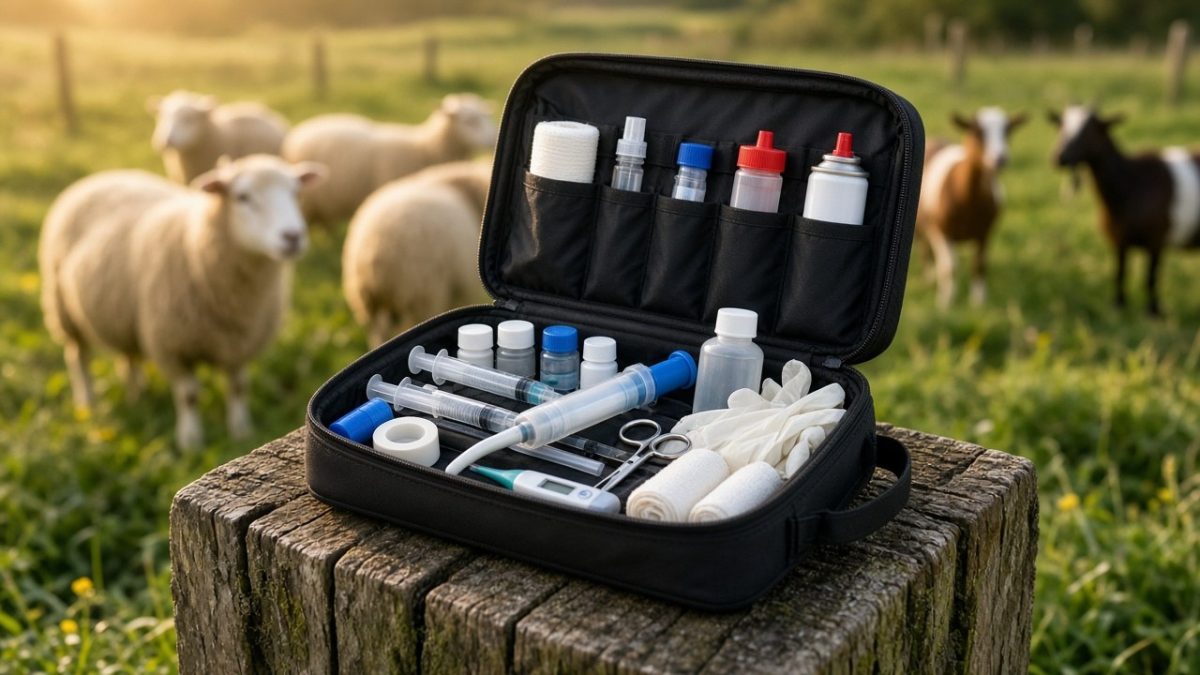
Having a well-stocked basic veterinary first aid kit on the farm can make the difference between solving a problem in time and losing an animal. A lameness case, a fly-struck wound, a lamb with diarrhea or a ewe down at lambing will not wait for the vet clinic to open. Having the essentials at hand lets you act fast, and knowing when to call the veterinarian saves you from costly mistakes.
In this guide we explain what a first aid kit for sheep and goats should contain, how to store it, what to watch out for with medicines and how to keep a record of every treatment.
Why keep a first aid kit on the farm?
Training booklets for goat producers, such as the FUNDAPAZ guide on animal health in the Argentine Chaco, repeat a simple idea: prevention is better than cure, and an animal that starts to get sick and is treated right away needs fewer medicines and recovers faster. For that you need basic supplies on hand, along with clean water, feed all year round, salt, a minimum preventive health plan and a daily check of the animals, especially at lambing/kidding and during drought.
Institutions such as Argentina’s INTA also recommend that producers keep a health kit in the corrals for everyday flock management.
How to put together and store the kit
- Use a clean, dry box or case with a lid, labeled and easy to reach, but out of children’s reach.
- Store medicines in cool, dark places: sunlight and heat can make them lose effectiveness. Anything that needs a cold chain (for example vaccines and some injectables) goes in the fridge, not frozen.
- Check expiry dates. An expired product does not work and can be risky; dispose of it following the manufacturer’s or your veterinarian’s instructions, away from people and animals.
- Keep an inventory of what you have, quantities and expiry dates, and restock as soon as something is used.
- Learn the active ingredient of each product: brand names change, but the drug that does the work is the same. That lets you compare prices and brands with good judgment.
What a basic veterinary first aid kit should include
The exact list depends on your system, your region and the health plan you build with your veterinarian. This is a guiding base for sheep and goat flocks.
Tools and working supplies
- Digital rectal thermometer. Normal temperature in adult sheep and goats is around 38.5 to 40 °C (101.3 to 104 °F); a fever is often the first sign of infection.
- Syringes of different volumes and needles of various lengths and gauges (thinner ones for lambs and kids).
- Drench gun (for oral dewormers) and a large syringe for giving liquids by mouth.
- Scissors, forceps and a hoof knife or trimmers, clean and disinfected before each use.
- Disposable and long-sleeve gloves, obstetric lubricant, a flashlight and a marker or paint to identify treated animals.
Wound care
- Antiseptic (povidone iodine or chlorhexidine) and saline or clean water for washing.
- Gauze, cotton, bandages and adhesive tape.
- Fly-strike (maggot) spray or ointment and veterinary wound-healing products. Take care with aerosols on very young animals.
- 7% iodine for navel dipping of newborns.
For any wound, the first step is always to wash well with clean water to remove dirt and hardened blood, and only then disinfect. If there is fly strike, the maggots must be removed and the wound cleaned daily until it closes.
Prevention and health plan
- Internal and external dewormers, chosen according to fecal egg counts and the FAMACHA method, rotating active ingredients to slow resistance.
- Vaccines from the health plan for your region, especially clostridial vaccines (enterotoxemia, blackleg, gangrene), always kept cold.
- Selenium and vitamin E, vitamin and mineral supplements, if your veterinarian recommends them for your area.
Emergencies and support
- Oral rehydration solution for animals with diarrhea. A homemade option recommended in training booklets is 1 liter of boiled and cooled water, 2 tablespoons of sugar or honey and 1 level teaspoon of salt or baking soda.
- An energy source (such as propylene glycol) for ewes and does with signs of pregnancy toxemia, as directed by a veterinarian.
- Frozen colostrum or a substitute, a bottle and a feeding tube for weak or orphaned lambs and kids.
- Anti-inflammatories, antibiotics and other prescription medicines: only those your veterinarian has prescribed, with their dose, route and duration.
For lambing and kidding
- Long gloves, lubricant, clean obstetric string or rope, iodine for navels, towels, a bucket and good light.
- A few ear tags and an applicator to identify the young as soon as they are born.
What not to do with your first aid kit
- Do not self-medicate with antibiotics without good reason: unnecessary use creates resistance and can leave residues.
- Respect withdrawal times. Medicines pass into meat and milk; some stay a few days and others almost a month. Check the label before slaughter or before consuming or selling the milk.
- Do not mix products or use one syringe for every animal: change needles as often as needed.
- Do not use home remedies or strong purgatives without knowing what you are treating: they can worsen the problem and delay the consultation.
When to call the veterinarian
- High fever, depression, or an animal that is not eating or ruminating.
- Difficulty breathing, bloat or nervous signs.
- Diarrhea that does not improve within 24 hours, especially in young animals.
- Lambing problems, retained placenta or prolapse.
- Several sick animals at the same time or unexplained deaths.
Community kit: an idea for producer groups
In many rural areas producers set up a community veterinary kit. FUNDAPAZ’s experience recommends agreeing on rules in advance: where it is kept, who manages it, how used medicines are replaced and a sheet recording date, family, medicine, quantity and amount. It is a practical way to share costs and always have what you need.
Record every treatment with OvinApp
A tidy kit works best when you know what you gave each animal and when. With OvinApp, the free app for managing sheep and goats from your phone, you can record health events (vaccines, deworming and treatments), note withdrawal times and set up the calendar and alerts so you do not forget the next dose, a vaccine booster or a re-check of a treated animal.
Frequently asked questions
What is the bare minimum a sheep and goat first aid kit needs?
A thermometer, syringes and needles, a drench gun, antiseptic, wound-care supplies, fly-strike treatment, oral rehydration solution, gloves and the products of your health plan (dewormer and vaccines). Your veterinarian defines the rest according to your system.
How often should I check the kit?
Review it every few months and always before critical periods such as lambing, breeding or shearing: check expiry dates, restock what you used and clean the box.
Can I use medicines made for cattle or other species?
Some active ingredients are used across species, but doses and withdrawal times change. Always check with your veterinarian before using a product that is not labeled for sheep or goats.
Do home remedies replace medicines?
They can be a support for mild problems at the start, and they are part of the traditional knowledge of many producer families. But if the animal does not improve quickly or the condition is serious, call the veterinarian without delay.
Conclusion
A clean, organized and up-to-date basic veterinary kit is one of the cheapest investments in animal health. Build it with your veterinarian’s help, check expiry dates, respect withdrawal times and record every treatment. That way you will act faster and with more confidence when an animal needs it. This article is for guidance only and does not replace veterinary advice.
Sources
- FUNDAPAZ. Zona Caprina No. 8: Sanidad Animal en el Chaco Salteño. La experiencia de los Grupos de Mujeres de Santa Victoria Este (2003). https://www.fundapaz.org.ar/wp-content/uploads/2015/05/Sanidad.pdf
- INTA EEA La Rioja. Aguilera, N. G. El botiquín sanitario caprino (2019). https://repositorio.inta.gob.ar/handle/20.500.12123/17179
- NC State Extension. Lambing and Kidding Cheat Sheet for Beginning Small Ruminant Producers. https://content.ces.ncsu.edu/lambing-and-kidding-cheat-sheet-for-beginning-small-ruminant-producers
- Clemson Cooperative Extension. What to Include in a Livestock First Aid Kit. https://lgpress.clemson.edu/publication/what-to-include-in-a-livestock-first-aid-kit/