
Footrot in sheep and goats: causes, treatment and control
November 16, 2026
Purity Grades in Sheep and Goats: Fractions, Upgrading, and Registry
November 19, 2026Dog Attacks on Sheep: How to Protect Your Flock from Predation
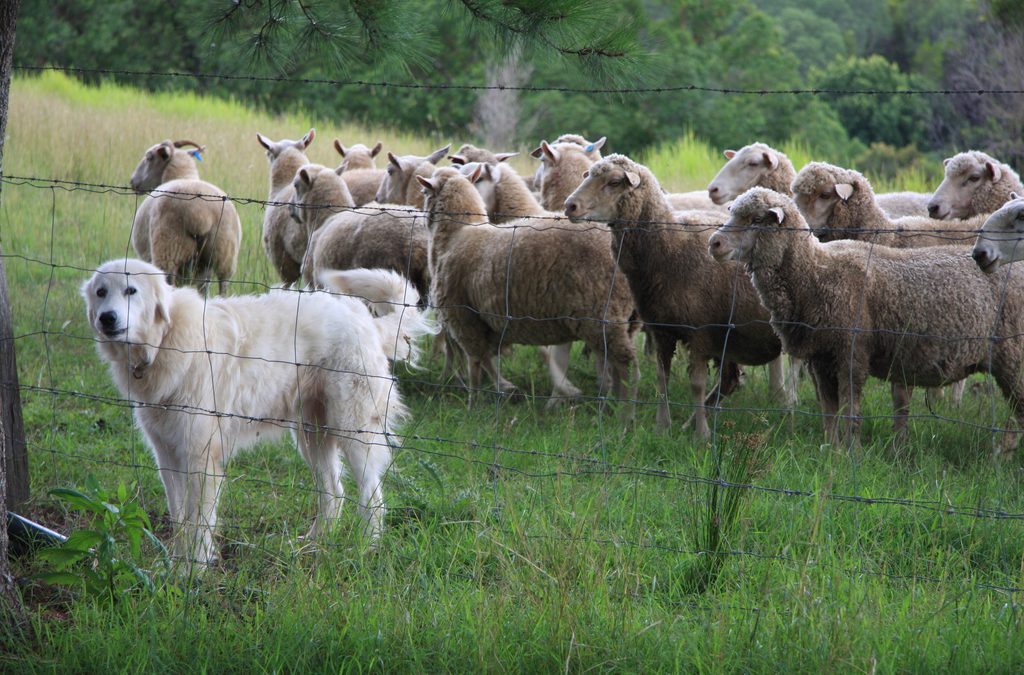
Andy Fitzsimon, Wikimedia Commons, CC BY-SA 2.0. Fuente / Source / Fonte.
Dog predation is one of those problems you feel in the field before it shows up in a spreadsheet: dead or missing animals, a stressed flock, nights of watching, and the sense that one fence is not enough. In Chile, the issue has moved from rural anecdote to a technical field of work. INIA Carillanca is evaluating collars with ultrasound, high-intensity LED lights, motion sensors, and GPS as complements to the protection measures already used in extensive systems.
The key is to set expectations correctly: none of these tools replaces management, fencing, or a guardian dog, and none has been proven as a definitive solution in every condition. What follows is what the main source says, including its limits and cautions.
The Problem: What SAG Data Shows
According to records from Chile’s Servicio Agrícola y Ganadero (SAG) cited by INIA Chile, since 2012 dogs have been involved in 29% of registered predation cases in the country, affecting more than 10,000 animals. That is a record-based figure, not a census of all losses: it helps size the problem, not estimate what each farm loses.
The project is called “Mitigación del impacto de perros asilvestrados en la ganadería ovina de La Araucanía.” It is supported by Corfo Araucanía and carried out by INIA Carillanca, with extension specialists Dr. Francisco Canto and Gabriela Chahín, the Cooperativa Ovinos Victoria, and the Universidad Austral de Chile (UACh). The full release is on INIA Chile.
What Already Works: Traditional Measures
INIA starts from a sensible base: the new technologies are meant to complement electric fences, guardian dogs, protective donkeys, and more vigilance. It is not a choice between old and new, but a matter of adding layers of protection.
In practice, that means checking the perimeter and the places where a dog can get in, securing night confinement, and keeping the flock under observation. Technology can warn or deter, but the response is still human: someone has to interpret the alert, reach the paddock, and decide what to do. If the problem is already established, add veterinary and technical advice, because other causes of death or stress also need to be ruled out.
Deterrent Collars with Ultrasound and LED
Among the alternatives under evaluation are collars that emit high-frequency acoustic signals and, in some models, high-intensity LED lights. They can be placed on some animals in the flock, not necessarily all of them. The idea is to create an unexpected stimulus when a dog approaches: dogs can detect high-frequency sounds better than sheep and goats, so the sound is designed to bother the predator without disturbing the flock in the same way.
Some models add regular or irregular flashes, and the devices can activate automatically through sensors that detect movements associated with a possible attack or sudden changes in flock behavior. That is how Dr. Francisco Canto, a specialist at INIA Carillanca, explained it. This is a description of how the devices are meant to work, not a promise of results: their effectiveness under southern Chile conditions is still being evaluated.
There is an important difference between “deterring” and “protecting.” A collar may scare a dog one night and fail another, or behave differently with a free-roaming dog than with a feral one. That is why INIA presents these devices as an emerging, complementary alternative, not as a replacement for fencing or a guardian dog.
GPS Collars and Motion Sensors
The other line is GPS collars with motion sensors, designed to monitor location and activity. If the system detects a sudden change in movement or behavior — a situation that could be associated with a predator attack, theft, or another risk — it can send an alert to the producer by phone call or mobile app. Once the alarm is activated, GPS shows the animal’s location and allows real-time tracking. That is how Gabriela Chahín, an extension specialist at INIA Carillanca, explained it.
These collars do not prevent an attack on their own: they warn so someone can act. Their value is in shortening the time between the event and the response, and in showing where to look. The technology was validated at the San Manuel farm in the commune of Victoria, owned by sheep producer Anne Marie Hetz. In her experience, GPS collars made it possible to locate animals more precisely within the farm and made surveillance easier; the system also issued alerts during high-activity episodes.
That is what the source attributes to that farm: experience with GPS, location, and high-activity alerts. It does not report a quantified reduction in attacks, and that case does not prove the ultrasound/LED collars are effective.
The Limits INIA Points Out
INIA is explicit: implementation costs, connectivity conditions, and device effectiveness still need to be evaluated under the production conditions of southern Chile, particularly against free-roaming or feral dogs. Connectivity is not a minor detail on extensive farms, and the cost of a collar per animal can change the equation entirely.
The realistic recommendation is to test, measure, and compare before scaling up. If you are going to invest, start with the animals and paddocks where the problem is most frequent, and record what happens before and after. The decision should not rest on enthusiasm for technology alone.
Guardian Dogs: The Experience in Uruguay
While the collars are being evaluated, guardian-dog breeding has a longer field record in the region. INIA Uruguay published Bulletin No. 119 in 2021, by Andrés Ganzábal, on raising a good livestock guardian dog. The program distributed and evaluated more than 700 guardian dogs, and more than 1,000 producers are reported to have adopted the tool, including private breeders. On the surveyed farms, the program reports more than 85% effectiveness, expressed as a decrease in predator activity against sheep.
That 85% needs to be read precisely: it is the result reported on the surveyed farms, not a guarantee for every operation. Effectiveness depends on dog selection, imprinting, management, and the consistency of the system. The INIA Uruguay document is available at INIA Uruguay, BD 119 (2021).
Imprinting is the sensitive period in which a puppy learns to recognize sheep as its social group. The bulletin places it at roughly 45–60 to 75–90 days of age. The imprinting pen should be away from the houses, and non-guardian dogs on the farm should not frequent it. The program’s breeds are Maremmano Abruzzese, Pastor de Pirineo, and their crosses.
The Sociedad Uruguaya de Lana (SUL) also validated Maremma breeding on family farms and stresses that puppies should be born with sheep for good imprinting. The idea is simple and demanding at the same time: a guardian dog is not bought “finished”; it is raised, socialized, and supported. You can see SUL’s information at Maremma dog breeders.
Combining Tools
A reasonable scheme combines layers: night confinement and fence checks; well-raised, well-fed guardian dogs; human presence and vigilance; and, if budget and connectivity allow, alert or deterrent collars on some animals. Technology does not fix a system without management, but it can buy time to react.
It also helps to record what happens: date, paddock, affected animals, and the conditions of the attack. That record helps decide where to intervene and whether a tool is working. If losses repeat, ask your veterinarian and local technical services: diagnosing the cause and choosing a strategy cannot be solved with a collar alone.
Frequently Asked Questions About Dogs and Predation
Are ultrasound and LED collars already proven?
INIA Chile presents them as emerging technologies that could complement traditional measures. Costs, connectivity, and effectiveness under southern Chile conditions still need to be evaluated, especially against free-roaming or feral dogs. Do not treat them as a proven solution or as a replacement for fencing or a guardian dog.
How does a GPS collar work for a flock?
The collar monitors location and activity. If it detects a sudden change consistent with an attack, theft, or other risk, it can alert the producer by call or app and show the animal’s location. It does not prevent the attack by itself: it helps you respond faster.
How long is the imprinting period for a guardian dog?
INIA Uruguay’s bulletin places it at roughly 45–60 to 75–90 days of age. The imprinting pen should be away from the houses, and non-guardian dogs should not frequent it. SUL stresses that puppies should be born with sheep.
Can any dog work as a guardian dog?
No. INIA Uruguay works with Maremmano Abruzzese, Pastor de Pirineo, and crosses, and SUL validates Maremma breeding on family farms. Imprinting, selection, and management are part of the result: a guardian dog is not a pet left loose without support.
What should I do if I see dogs roaming or an attack?
Put your safety first: do not confront the dogs. Secure the flock and the enclosure, and call your veterinarian and the appropriate authority. If you have GPS collars, use the alert and location to check the paddock. Record what happened so you can evaluate it with technical assistance.
Does technology replace a guardian dog or electric fence?
No. INIA presents the collars as a complement to electric fences, guardian dogs, protective donkeys, and greater vigilance. Management remains the base: confinement, fence checks, human presence, and veterinary assistance when losses occur.
Sources
- INIA Chile, November 6, 2026: With support from Corfo Araucanía, INIA explores new technologies to protect sheep from feral dogs.
- INIA Uruguay, Andrés Ganzábal, Guía práctica para la educación de un buen perro pastor, Bulletin No. 119, 2021: PDF.
- SUL, Maremma dog breeders: sul.org.uy.
Report attacks and livestock theft on the map
If you had a dog or predator attack, or a case of livestock theft, log it on OvinApp’s map of attacks and deaths in sheep flocks. It records the area so other producers can see what is happening.
Record your flock with OvinApp
OvinApp is an app for sheep and goat management. The free plan covers up to 20 animals. Record your flock and health checks from your phone. Ask your veterinarian before treating.