
Dog Attacks on Sheep: How to Protect Your Flock from Predation
November 19, 2026
Sheep Reproduction: Estrous Cycle, Fertility, and Probable Lambing Date
November 21, 2026Purity Grades in Sheep and Goats: Fractions, Upgrading, and Registry
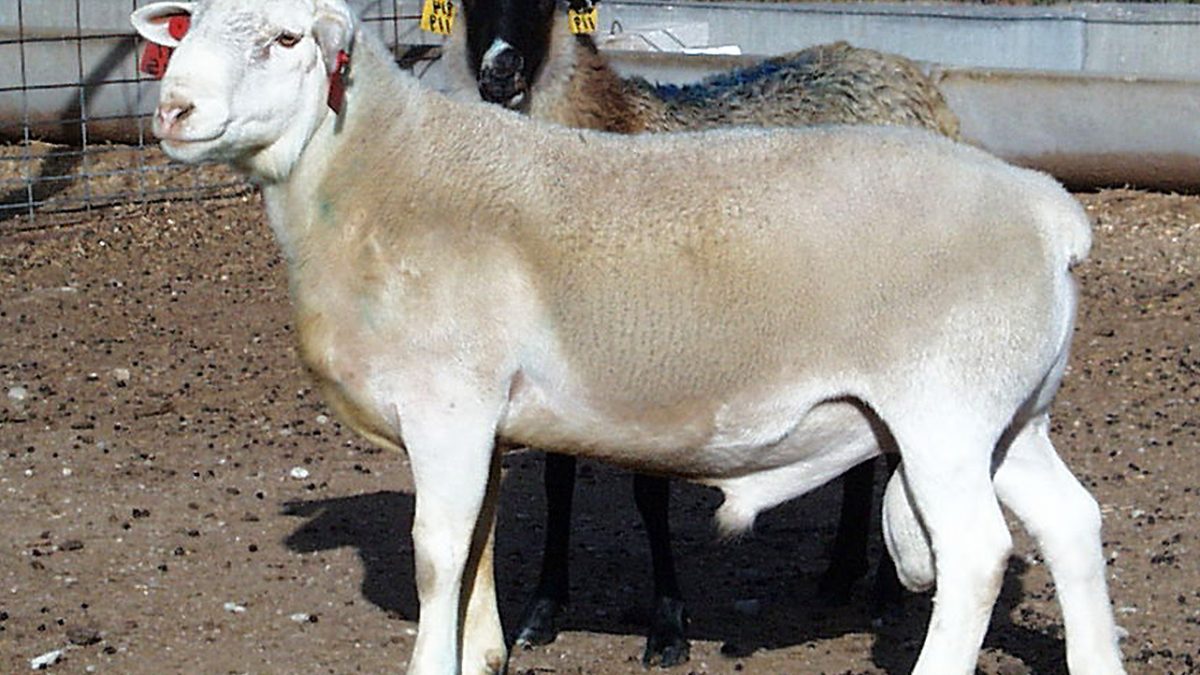
Kreg Leymaster, Agricultural Research Service (USDA). Dominio público. Wikimedia Commons, File:Dorper_white_ram.jpg.
A purity grade is shorthand for how much of an animal’s racial composition is attributed to a target breed. In an upgrading program it helps plan each generation: the female line carries the accumulated fraction while a pure male of the target breed is used again. It is a management tool, not a certificate.
Two planes are easy to confuse. Racial composition is an estimate obtained by averaging the grades of the sire and the dam. Registry category is a status defined by each breed association and may depend on inspection, tattoo, age, fleece, or registered parents. Two animals with the same fraction can have different registry status.
How racial composition is calculated
The calculation is an average: (sire’s fraction + dam’s fraction) ÷ 2. A 3/4 sire and a 7/8 dam produce 13/16, or 81.25% of the target breed. That figure helps sort the flock and plan the next mating; it does not replace the registry.
With a pure male at every step, the sequence is 1/2 (pure × another breed, 50%), 3/4 (pure × 1/2, 75%), 7/8 (pure × 3/4, 87.5%), 15/16 (pure × 7/8, 93.75%), and 31/32 (pure × 15/16, 96.875%).
On-farm tool
Purity-grade calculator
Choose the sire’s grade and the dam’s grade. “Breed composition” averages the two fractions. “ARU rule” applies article 62 of the herdbook regulations of the Asociación Rural del Uruguay (Rural Association of Uruguay): one generation higher than the lower-grade parent; if the sire is registered pedigree, one generation higher than the dam. That rule applies only to animals registered in Uruguay. This is not a certificate or a registration filing.
Choose both grades to see the offspring result.
Two modes. “Racial composition” applies the average. “ARU art. 62 rule” counts generations: the offspring is one generation above the lower-grade ancestor. ARU’s official example: a first-generation sire and a third-generation dam produce a second-generation offspring. If the sire is a registered pedigree animal, the offspring is one generation above the dam.
The modes can diverge. With a 3/4 sire and a 7/8 dam, the average is 13/16; the rule, read on a generation scale, gives a third-generation animal. ARU does not define the fractions; the 1/2, 3/4, 7/8 equivalence comes from ARCO and SIROC. The calculator is an orientation aid; it does not certify an animal or start a registration file.
Generation table
Classic sequence
Generations of absorptive crossing (grading up)
Usual scheme when the sire is pure (fraction 1) and is used over successive generations on ewes of the other breed or of a lower grade. Percentages match the scheme published by ASOOVINOS (SIROC 2024). Registry notes are not universal.
| Generation | Typical mating | Fraction | Percentage | Registry notes (not universal) |
|---|---|---|---|---|
| F1 · 1st | Pure × base or another breed | 1/2 | 50% | Half-blood. In ARCO, an intermediate product under generation control. |
| F2 · 2nd | Pure × 1/2 | 3/4 | 75% | Under ARU (Uruguay), if the sire is registered pedigree, the generation is one higher than the dam’s. |
| F3 · 3rd | Pure × 3/4 | 7/8 | 87.5% | Temporary ARU (Uruguay) exception in Merilín: progeny of a third-generation Double Tattoo ram may enter definitive pedigree if accepted (art. 72). |
| F4 · 4th | Pure × 7/8 | 15/16 | 93.75% | ASOOVINOS: PPC (puro por cruza) at 15/16 if the parents hold purity records. ARU (Uruguay): at least four generations for definitive pedigree, plus extra conditions for P.N.O. sheep. |
| F5 · 5th | Pure × 15/16 | 31/32 | 96.875% | ARCO: target composition 31/32 as PC (puro por cruzamento). ASOOVINOS: also PPC. |
Rows: 1st, 1/2, 50%, pure × another breed; 2nd, 3/4, 75%, pure × 1/2; 3rd, 7/8, 87.5%, pure × 3/4; 4th, 15/16, 93.75%, pure × 7/8; 5th, 31/32, 96.875%, pure × 15/16. Registry reference: ARCO uses CG, with a number for intermediates; SIROC uses PPC from 15/16; ARU counts generations and does not set fractions.
Diagram of the upgrading scheme
At a glance
From half-blood to 31/32
Each step assumes one pure parent of the target breed. If both parents are intermediate, composition is the average of their fractions; the ARU generation does not always match that average.
The diagram keeps one structure: a pure male of the target breed over a female carrying the accumulated fraction. The next generation’s female is retained; the male is replaced by another pure one. That is how the program moves from 1/2 to 31/32.
What the registries say
Uruguay (ARU, Asociación Rural del Uruguay / Rural Association of Uruguay). Its herdbook rules apply only to animals registered in Uruguay; in other countries, the rules of the relevant breeders’ association or breed registry apply. The 2019 General Regulations cover pedigree by absorption in articles 61 to 69. Base males and females that meet the breed requirements may be registered after selection by the breed society’s inspector (art. 61). Generation follows the art. 62 rule; breed societies and RR.GG. regulate the number of grades, and RR.GG. requires at least four generations to reach definitive status (art. 63).
P.N.O. sheep have additional requirements: at least the fourth generation, the second-fleece stage (cutting or about to cut the four permanent teeth), and sufficient wool development, about six months (art. 70). At the breeder’s request, a committee with an ARU delegate, a breed-society delegate, a sheep improvement technician, and an RR.GG. official reviews the animal. It must reach the Doble Tatuaje (double tattoo) level; if accepted, it moves to Pedigrí Definitivo with the same rights as the offspring of registered pedigree parents (art. 71). Article 73 provides export certificates for breeding animals that are Puros de Origen y de Calidad (pure of origin and quality); each breed society establishes the Puro de Origen condition.
The regulations do not define 1/2, 3/4, 7/8, 15/16, or PPC for sheep, and they do not equate “definitive” with 15/16 or 31/32. P.N.O. appears without expansion; a Uruguayan rural press article calls it “Pedigree Nacional Ovino,” a journalistic usage, not an official definition.
Brazil (ARCO). The registry of the Associação Brasileira de Criadores de Ovinos (ARCO), under MAPA delegation, describes the categories PO (Puros de Origem), POB (Puros de Origem Brasileira), PC (Puros por Cruzamento, with defined racial character, from herds at the RD level or from crosses under genealogical control), PCOD, PCOC, PCRB, and crossbred females under genealogical control. The goal of absorption crossing is 31/32 composition for PC. Intermediates at 1/2, 3/4, 7/8, and 15/16 (first to fourth generation) carry a “CG” tattoo plus the generation number. Males of the absorbing breed must be registered at least as PO, PCOC, or PCOD; offspring of the fourth generation (CG5) may be selected for the PCOD tattoo. ARCO keeps the Livro de Registro de Cruzamentos Absorventes. See McManus et al. (2023).
Colombia (ASOOVINOS). SIROC 2024 places sheep and goats from absorption crosses that have 15/16 purity and parents with Registros de Pureza in the Libro tipo B, the purity-grade registry, identified as PPC (Puro Por Cruza). The scheme: pure breed A × another = F1 1/2 (50%); pure × 1/2 = F2 3/4 (75%); pure × 3/4 = F3 7/8 (87.5%); pure × 7/8 = F4 15/16 (93.75%) PPC; pure × 15/16 = F5 31/32 (96.875%) PPC. Outside this scheme, the percentage is determined from the percentages of the parents’ breeds (paragraph 2).
The rules are not universal. Uruguay centers on generation and definitive pedigree; Brazil sets 31/32 composition as the goal for PC; Colombia recognizes PPC from 15/16 and also at 31/32. ARU’s registry service puts it this way: keeping “registros de absorción y genealogía de animales puros por cruza” in the breeds that require it.
Upgrading versus terminal crossing
Absorption is not the same as terminal crossing. An absorption program raises the share of one breed over generations and keeps females for the next step. A terminal cross aims at a final product and does not build that ladder. Absorption is a tool within genetic improvement: without selection, the fraction alone does not improve the flock. See what genetic improvement means in sheep and goats.
Keeping the thread on the farm
On the farm, genealogy is the weak point. Identify each animal and note sire, dam, breed, and mating date. The animal record stores name, identifier, parents, photo, breed, and birth type; that keeps the thread of generations. It is not a genealogical registry and does not assign categories.
Breed profiles
Dorper, Katahdin, Boer, Merino, Corriedale, and Hampshire Down.
Frequently asked questions
Are 1/2, 3/4, or 15/16 already “pure”?
Not automatically. The fraction describes composition; registry category is separate. Colombia places 15/16 (and 31/32) animals in PPC when the parents hold Registros de Pureza; Brazil sets 31/32 as the PC goal; ARU does not define fractions and requires at least four generations for definitive status, plus P.N.O. requirements for sheep.
Are PPC, PC, and P.N.O. the same thing?
No. PPC is Puro Por Cruza under Colombia’s SIROC (15/16 and 31/32, parents with Registros de Pureza). PC is Puros por Cruzamento in ARCO’s Brazilian registry, with a 31/32 goal. P.N.O. is an ARU regulation label written without expansion; the Uruguayan rural press uses “Pedigree Nacional Ovino.” Three different scopes.
How is the grade calculated if the sire is 3/4 and the dam 7/8?
By composition: (3/4 + 7/8) ÷ 2 = 13/16 (81.25%). Under ARU art. 62, one generation above the lower-grade ancestor: if 3/4 is second generation and 7/8 is third, the offspring is third generation. ARU does not define the fractions; that reading comes from ARCO and SIROC. The two calculator modes can therefore differ.
How many generations does ARU require for definitive pedigree?
In ARU’s registry in Uruguay, at least four (art. 63). For P.N.O. sheep, add the second fleece stage (cutting or about to cut the four permanent teeth), sufficient wool development (about six months) (art. 70), committee review, and the Doble Tatuaje level (art. 71).
Does the calculator replace the genealogical registry?
No. It indicates composition and, in the other mode, the art. 62 generation rule. It does not certify, register, or replace inspection or the association’s category. The filing is done with the breed society or association.
Closing
Planning with fractions helps, but the backing comes from the registry and selection. Write down parents and breed, check what your association requires before calling an animal “pure,” and use the calculator as an orientation aid.
OvinApp lets you record name, identifier, parents, photo, breed, and birth type; the free plan goes up to 20 animals. Start at OvinApp for sheep and goats.