

Ovine and caprine fasciolosis: the liver fluke and the saguaypé
November 7, 2026Sterile Flies Against New World Screwworm: Did SIT Work Worldwide? (Uruguay’s San José Plant)
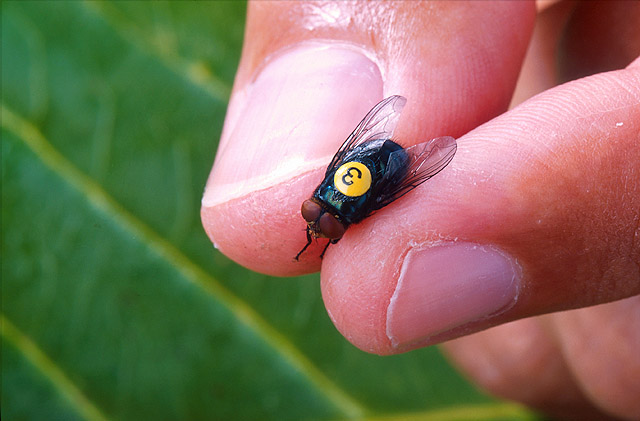
Peggy Greb, USDA ARS (K9355-1). Public domain / Dominio público. Source / Fuente / Fonte
What screwworm is and why it matters
Screwworm is a form of myiasis caused by the larvae of Cochliomyia hominivorax, the New World screwworm fly. Females lay their eggs at the edges of wounds or in openings such as the nose, ears, genitals and the navel of newborns; the larvae feed on tissue and the infestation can be fatal (APHIS).
In sheep and goats, the risk is mixed with routine work: shearing, tail docking, earmarking and births open handling wounds that can be left exposed. To gauge its scale, it is enough to review five diseases of sheep and the place myiasis occupies. Nor should screwworm be confused with the nasal bot fly (Oestrus ovis), which is something else (OvinApp).
How the sterile insect technique works
The sterile insect technique (SIT) follows a specific sequence: raising the flies in a laboratory, irradiating the pupae with gamma radiation so that the males become sterile, and then releasing them in the field. The radiation does not affect the males’ longevity, mate-finding or mating (APHIS). What matters here is the principle, not the laboratory detail: SIT is not an insecticide.
The mechanism is biological. Females of C. hominivorax normally mate only once; if that mating is with a sterile male, they lay eggs that produce no offspring. With sustained releases, the wild population declines progressively (APHIS; San José Ahora). The release poses no risk to wildlife, livestock or people, according to the same agency (APHIS).
What distinguishes a serious program from a promise is scale and continuity. SIT is integrated with surveillance and other control measures, and combined in this way it is an effective tool (APHIS). It cannot be sustained with isolated releases: it requires raising, irradiating and releasing on a sustained basis, with monitoring.
Did it work worldwide?
The most cited precedents are in the United States. SIT was used successfully as part of integrated management to eradicate the pest from the Southeast in 1959 and from the Southwest in 1966, according to the IAEA’s listing (IAEA). The program began in the south of that country in the 1950s; the country was declared free of the pest in 1966 and the first biological barrier was established on the border with Mexico (COPEG).
Mexico achieved eradication in 1991 and Central America completed the process between 1994 and 2004, according to the IAEA (IAEA). In 1994 the agreement creating COPEG was signed and official eradication began in 1998; in 2006 Panama was declared free except for the province of Darién, where a permanent biological barrier remained (COPEG).
Libya showed another scale. The fly invaded North Africa in the late 1980s, was detected in 1988 and confirmed in 1989; the SIT-based program cost about US$80 million and released 1,400 million sterile flies produced in Mexico over 40,000 km² between December 1990 and October 1991, with total eradication, strict quarantine, animal inspection, trapping and an information program (INIS). The IAEA lists Libya with 1992 as the year of eradication (IAEA).
Florida provided a recent and limited test. On September 30, 2016, the NVSL laboratory confirmed an autochthonous case in the Key deer on Big Pine Key: the first sustained, reproducing population in the United States since 1966, which was eradicated from Florida with a multi-agency response (PubMed (JAVMA)). Sterile pupae were placed in chambers from October 11, 2016, work was done on 13 infested keys with 35 release stations, and eradication was declared on March 23, 2017 (PubMed (JME)). APHIS reported that close to 154 million sterile flies had been released by that date, that there had been no new cases since January 10, and that elimination is achieved three life cycles after the last detection, with an average cycle of 21 days (APHIS).
The later resurgence calls for lowering the triumphalist tone. COPEG’s chronology records the emergency in Panama in January 2023, the declaration of a national outbreak by MIDA on July 5, releases in Costa Rica in late July, the first case in Nicaragua in December 2023, the first case in Honduras in September 2024 and the start of dispersal in Mexico on November 30, 2024; in 2025 releases were suspended in the rest of Central America to concentrate them in Tuxtla and set up a barrier across the Isthmus of Tehuantepec (COPEG). APHIS confirms that since 2023 the pest has reappeared in every Central American country and in Mexico (APHIS).
The United States is not outside the picture: APHIS publishes confirmed detections and maps of infested areas in Texas, New Mexico and Arizona, with the weekly dispersal polygon for sterile flies (APHIS). Production is being expanded: Pacora, in Panama, co-managed by the USDA and Panama’s Ministry of Agricultural Development, can produce more than 100 million pupae per week during an outbreak (APHIS); Metapa, in Mexico, finished construction in late June 2026 and is moving toward 100 million per week after US$21 million in investment; Moore Air Base, in Texas, is being built with 300 million per week projected (APHIS).
The balanced conclusion is that SIT worked as part of integrated management across entire areas, but it is not immune to reinvasion. The IAEA recalls that success requires reducing wild populations by at least 60% before introducing the technique and that maintaining free areas is a challenge being faced once again, with a need for better surveillance, control and expanded mass rearing (IAEA).
Uruguay and San José: what is planned
Uruguay has been assembling its own program. The Screwworm Eradication Program (Programa de Erradicación de la Bichera, PEB), run by the MGAP through the Directorate General of Livestock Services (DGSG), is developing the capacity to raise, irradiate and disperse sterile flies, within the framework of the IAEA’s RLA5088 technical cooperation project, with participation from INIA, Dilave and the School of Veterinary Medicine (MGAP; Búsqueda). In Migues, last year’s trials assessed dispersal, quality and reproductive compatibility between irradiated and field flies, and showed compatibility (Búsqueda).
External supply was the first setback. The original design called for importing sterile pupae and completing the final stages, quality control and release in Uruguay; difficulties in obtaining insects in Panama and Mendoza, and the impossibility of importing them because of the resurgence of screwworm in Central America, Mexico and the United States, delayed progress (Búsqueda). In July 2025 the MGAP was preparing trials at the School of Veterinary Medicine’s experimental field in Migues and negotiating an agreement with Mendoza’s ISCAMEN to obtain insects for tests (San José Ahora).
The alternative is a modular plant in San José, planned for next year, with an estimated investment of around US$1 million. The head of the Animal Health trust, Carlos Corujo, described it as an expandable and even relocatable facility, to be developed in stages, with no defined production scale because it depends on trained staff (San José Ahora; Búsqueda). In the minutes of the April Conahsa meeting, Corujo noted that mass rearing is the program’s «Achilles’ heel» because of its space and infrastructure requirements (San José Ahora).
The regional front also matters. Daniel Salada, of the National Rural Development Commission (Comisión Nacional de Fomento Rural), raised at that same meeting the uncertainty over neighboring countries’ measures and warned that, without regional control, Uruguay might need to maintain sterile fly production and release permanently (San José Ahora). This year a risk map for Colonia, San José and Canelones is being validated with traps, taking into account farm size, the coexistence of sheep and cattle, water and woodland; the species captured are identified and outreach is done with producers; drones are under study and the purchase of aircraft was dropped (Búsqueda).
Limits and what producers can do in the meantime
SIT alone is not enough. The USDA itself recommends integrating it with surveillance and other measures (San José Ahora), and the South American context complicates any illusion of isolation: the pest is present throughout South America except Chile (APHIS). Add to that regional control: if neighboring countries do not join in, the national effort may remain exposed, and wound management remains part of the package.
In the meantime, producers can take concrete steps, and none of them replaces the veterinarian. Checking animals frequently, planning the handling that creates wounds —shearing, tail docking, earmarking, births— and consulting the veterinarian about any doubt are the basic steps; also reporting and following the official MGAP and DGSG channels, and cooperating with trapping or outreach if their area participates. To organize that task, the reading on flies in sheep, the basic veterinary kit, health management and tail docking and the health plan are useful.
Frequently asked questions
Do sterile flies bite?
APHIS maintains that the release of sterile flies poses no risk to wildlife, livestock or people, and that matings with sterile males produce infertile eggs (APHIS). The sources consulted do not provide further detail on this point.
When would results be seen?
There is no defined date or volume for Uruguay: the plant is planned in stages and its scale depends on trained staff (San José Ahora). The precedents show different paces: in Florida, about six months passed between the limited outbreak and the eradication announcement (PubMed (JME)), and in Libya the release extended over about ten months across 40,000 km² (INIS). Uruguay is only now going through the preparation stages (San José Ahora).
Eradicate or control?
The IAEA presents SIT as an eradication tool within an integrated system, but warns that keeping areas free is a permanent challenge and requires more surveillance and mass rearing (IAEA). Salada, of the CNFR, warned that without regional control Uruguay might need permanent production and release (San José Ahora), which in practice looks more like sustained control than a one-time eradication.
The modular plant in San José is one piece of that puzzle, not the complete solution (San José Ahora). Its value will depend on the scale it reaches, on the surveillance that sustains it and on the region joining in.