


Constipation in lambs and sheep: causes, signs and what to do
October 27, 2026Pelibuey sheep: characteristics, origin and meat production
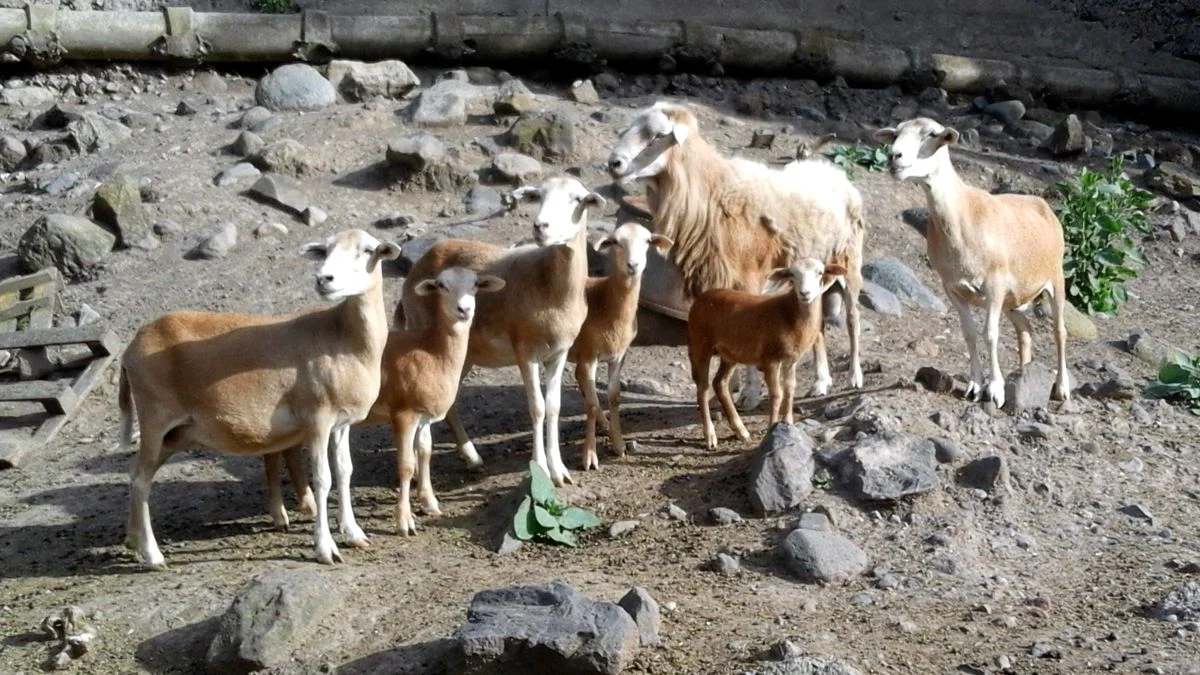
Pelibuey sheep in Gran Canaria. Photo: Beta15 / Wikimedia Commons, CC BY-SA 4.0. Cropped and color-adjusted.
The Pelibuey sheep is a hair sheep, with no wool, known for its hardiness and its adaptation to tropical climates (RFEAGAS). In Mexico it is one of the main sheep breeds and, since 1963, the most studied one (Aguilar-Martínez et al., 2017). Here we go through its origin, what it looks like, how much it weighs, how it reproduces, its meat, and its pros and cons, using data from official and scientific sources. If you are comparing breeds, also take a look at our guide to the 10 best hair sheep breeds.
What is the Pelibuey sheep?
The Pelibuey is a breed of hair sheep. In Spain’s official catalog it appears as the Canaria de Pelo (“Canary Hair Sheep”), with “Pelibuey” as another name (MAPA), and RFEAGAS confirms that in the Canary Islands it is also known as Pelibuey. The name of the Canaria de Pelo breed comes from the Canary archipelago and from the fact that the animals have no wool and are covered in hair (MAPA).
Many Spanish speakers search for this breed as borrego Pelibuey or borrego catarino. None of the sources we consulted uses the name “catarino”, so we cannot confirm whether it refers to a variety or a color; in this article we talk about the Pelibuey breed, which is the name used by the official catalog and the scientific literature.
For a time it was popularly believed to be a cross between a sheep and a goat, but its chromosome number is 54, the same as the sheep species (Aguilar-Martínez et al., 2017). Its natural habitat is warm regions: tropical, subtropical and even arid; its adaptability has allowed it to settle in practically every agroecological region of Mexico (Aguilar-Martínez et al., 2017).
Origin and history of the Pelibuey sheep
From Africa and the Canary Islands to the Americas
RFEAGAS considers it to descend from the hairy sheep of West and Central-West Africa, and notes that there is evidence of its presence in the Canary Islands before the first settlers from mainland Spain arrived. According to MAPA, the aboriginal inhabitants raised a large hair sheep with a tendency to fattening; animals of this type were exported to the Americas on the first voyages after the discovery, where they adapted and multiplied in large numbers.
A scientific review adds that the Spanish brought these sheep to the Americas to feed the ships’ crews, and that it is not clear whether they came from West Africa or from the Canary Islands (Aguilar-Martínez et al., 2017). Today, in Spain, the breed is found only in the Canary Islands, spread across all the islands but especially in Tenerife; MAPA also reports that several breeders have reintroduced it “with great success” (MAPA). Even so, the Official Catalog of Livestock Breeds of Spain lists it among the threatened native breeds (RFEAGAS).
Arrival in Mexico
The Pelibuey is considered to have entered Mexico between 1930 and 1940, and it is thought to have reached the Yucatán peninsula from Cuba, although some authors believe it already existed in the country in the late 19th century. The authors conclude that the Mexican Pelibuey possibly comes from the Cuban one, and that an African origin can be presumed (Aguilar-Martínez et al., 2017).
In 1963, the National Livestock Research Center bought a group of woolless animals that were common at the time in Tabasco. In the 1990s the Pelibuey was estimated to account for between 90 and 95% of Mexico’s hair sheep; it is also the breed with the most individuals in the herd books, about 38,000, although that figure does not reflect the total population (Aguilar-Martínez et al., 2017).
Characteristics of the Pelibuey sheep
It is a sheep with a subconvex or convex profile, medium-sized (eumetric) and medium-lined, and very hardy. It has thick skin without folds and no wool (although a vestigial amount may appear on the back), with long hair covering the whole body (RFEAGAS).
Color varies depending on the source. In Spain, the coat is red, in different shades (RFEAGAS). In Mexico, three basic colorations are reported, brown, white and pinto (spotted), and sometimes areas of black coat (Aguilar-Martínez et al., 2017).
In Mexico two types coexist. The “traditional” one is small and slender-bodied, and predominates on small rural farms in tropical regions. The “new” one comes from crosses with other breeds, is larger and more muscular, is managed intensively and is sold as breeding stock (Aguilar-Martínez et al., 2017). Indiscriminate crossbreeding, especially with the Katahdin sheep, which it closely resembles, threatens the pure lines: animals appear with exaggerated weight, black spots or permanent wool fibers, traits that are not part of the breed type (Aguilar-Martínez et al., 2017).
Weight and size of the Pelibuey
Adult weight
Weights change with the country and the management. In Spain, for the Canaria de Pelo, ewes weigh between 45 and 55 kg and rams between 60 and 80 kg (RFEAGAS). In Mexico, the animals are described as small to medium-sized, from 35 to 80 kg. Early descriptions gave an approximate adult weight of 50 kg for males and 30 to 40 kg for females (Aguilar-Martínez et al., 2017).
Birth and weaning weight
In Mexico, lambs weigh between 2.5 and 3.4 kg at birth in single births, and less in multiple births. Weaning weight depends mainly on age (generally between 60 and 90 days) and ranges from 11 to 16 kg. In breeding stock from the herd books, raised in intensive systems with better management and feeding, birth weight is 2.9 kg and weaning weight at 75 days is 17.4 kg (Aguilar-Martínez et al., 2017).
Reproduction of the Pelibuey sheep
Puberty and first lambing
In Mexico, females reach puberty at approximately 230 days, weighing about 25 kg; another study reports 231.8 days and 27.6 kg. Age at first lambing, in the studies consulted, ranges from 447 to 477 days (Aguilar-Martínez et al., 2017).
Fertility and prolificacy
One of its main traits is high fertility, with values above 80% (92% and 80.4% in the studies reviewed). Prolificacy varies between 1.2 and 1.5 lambs per birth, and it can increase if feeding is managed during the breeding season. The reported lambing interval is 254 to 255.9 days. There are also flocks selected for high prolificacy, at 2.18 and a distribution of single, twin and triplet births of 15%, 51% and 34%, although that study did not determine the effect of flushing (Aguilar-Martínez et al., 2017).
Breeding activity almost all year round
Ewes from temperate climates only breed in autumn and winter. The Pelibuey has less reproductive seasonality than sheep that originated at latitudes above 35°: the rate of estrus throughout the year ranges from 20% to 66.6%, and some individuals show uninterrupted reproductive activity. This opens the possibility of more lambings over the productive life of the ewes (Aguilar-Martínez et al., 2017).
Managing the Pelibuey
The sources we consulted give no guidelines on health or housing, but they do point to these key factors:
- Production system: lamb mortality depends mainly on the system, and the largest losses occur in extensive systems compared with intensive ones (Aguilar-Martínez et al., 2017).
- Feeding at breeding time: managing it can increase prolificacy (Aguilar-Martínez et al., 2017).
- Grazing and by-products: in the Canary Islands, the breed shows good aptitude for grazing, although the usual system is the use of agricultural by-products; flocks range from fewer than 10 to 400 ewes (RFEAGAS).
- Pure lines: in Mexico it is recommended to conserve the breed and avoid indiscriminate crossbreeding (Aguilar-Martínez et al., 2017).
Meat production of the Pelibuey sheep
In Mexico, the Pelibuey is not very productive in terms of meat yield; its value lies in its adaptation to almost every agroecological region, its high fertility and its almost continuous reproductive activity (Aguilar-Martínez et al., 2017). That same source offers no data on carcass yield or meat quality, so we do not give any here.
There are growth data, though. In breeding stock in Mexico, average daily gain is 193 g during lactation and 198 g between days 75 and 150, with about 1.8 live lambs per birth (Aguilar-Martínez et al., 2017).
In Spain, the Canaria de Pelo is mainly geared to meat production, closely linked to the intensive farms of the islands, to which it supplies manure as fertilizer. The most representative lamb is the one of 12 to 18 kg live weight, with an average daily gain of 140 to 170 g from birth to 90 days in single births, and 120 to 145 g in twin births (RFEAGAS).
Pros and cons of the Pelibuey
Pros
- Hardiness and great capacity to adapt to tropical climates (RFEAGAS), subtropical and even arid ones (Aguilar-Martínez et al., 2017).
- High fertility (over 80%) and almost continuous reproductive activity throughout the year (Aguilar-Martínez et al., 2017).
- Hair instead of wool, with thick skin without folds (RFEAGAS).
Cons
- Limited meat yield in Mexico (Aguilar-Martínez et al., 2017).
- Indiscriminate crossbreeding puts the pure lines and their genetic diversity at risk (Aguilar-Martínez et al., 2017).
- Higher lamb losses in extensive systems than in intensive ones (Aguilar-Martínez et al., 2017).
- In Spain it is listed among the threatened native breeds (RFEAGAS).
Before deciding, compare it with other hair sheep breeds, such as the Dorper sheep and the Santa Inés sheep.
Frequently asked questions about the Pelibuey sheep
What is the “borrego catarino” (or “catarin”)?
It is a name many Spanish speakers use when searching for this breed, but none of the sources we consulted uses it, so we cannot confirm that it is a variety or a color. In Spain the official breed is the Canaria de Pelo, with Pelibuey as another name (MAPA).
Is the Pelibuey a cross between a sheep and a goat?
No. It was popularly believed to be, but its chromosome number is 54, the same as the sheep species, so it is a sheep (Aguilar-Martínez et al., 2017).
How much does a Pelibuey sheep weigh?
In Mexico, between 35 and 80 kg according to the review consulted (Aguilar-Martínez et al., 2017). In Spain, 45 to 55 kg for ewes and 60 to 80 kg for rams (RFEAGAS).
How fertile is the Pelibuey?
Its fertility is above 80%, prolificacy ranges from 1.2 to 1.5 lambs per birth in the studies in the table, and the lambing interval is 254 to 255.9 days (Aguilar-Martínez et al., 2017).
Is the Pelibuey good for meat?
In Spain, the Canaria de Pelo is mainly geared to meat production (RFEAGAS). In Mexico it stands out not for meat yield but for its adaptation and fertility (Aguilar-Martínez et al., 2017).
Keep your flock records with OvinApp
If you already raise Pelibuey sheep or plan to, recording weights, matings and births helps you check the figures we saw here against your own flock. OvinApp is a free app for keeping flock records, with a free plan for up to 20 animals. Learn more at ovinapp.com.
Sources
- MAPA (Spain’s Ministry of Agriculture): breed catalog, Canaria de Pelo (Pelibuey)
- RFEAGAS: Canaria de Pelo
- Aguilar-Martínez et al. (2017), “Origen, historia y situación actual de la oveja Pelibuey en México” (Origin, history and current situation of the Pelibuey sheep in Mexico), Tropical and Subtropical Agroecosystems 20: 429-439. DOI · copy on Redalyc (PDF)
- Featured image: photo by Beta15 / Wikimedia Commons, licensed CC BY-SA 4.0. Cropped and color-adjusted; shared under the same license.