
Pelibuey sheep: characteristics, origin and meat production
October 31, 2026Oxford Down Sheep: Origin, Characteristics, Weight and Meat
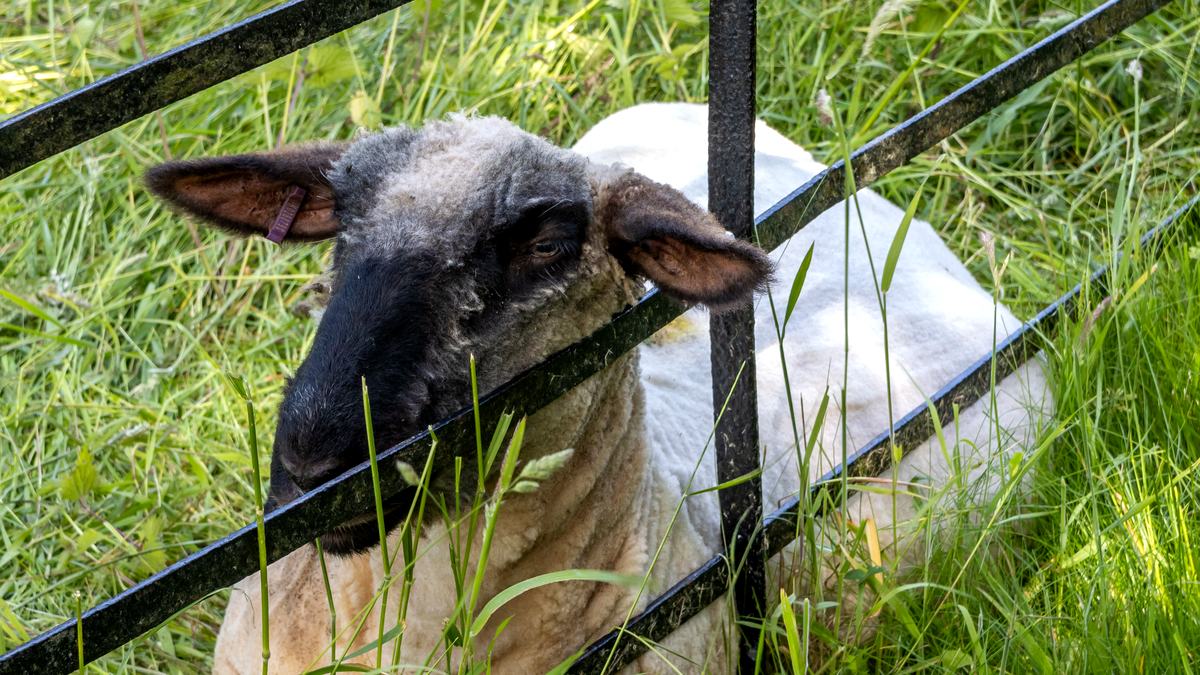
Oxford Down sheep at the Chiltern Open Air Museum. Photo: Mike Peel / Wikimedia Commons, CC BY-SA 4.0. Cropped and color-adjusted.
The Oxford Down sheep is a British meat breed developed in the 1830s by crossing Hampshire Down and Southdown ewes with Cotswold rams.[1][8] It is the heaviest of the Down breeds, has a dark face and a woolly topknot, and is polled (hornless).[3][6] Today it is used mainly as a terminal sire to produce heavy, lean lambs.[4][8]
In this guide to the Oxford Down breed you will see its origin, how to recognize it, how much it weighs, what wool it produces, how it breeds and how it differs from the Hampshire Down and the Suffolk. The figures come from the sources cited; where they differ, we show each source’s range.
Origin of the Oxford Down sheep
The UK breeders’ association and Wikipedia place the origin in the cross of Hampshire Down and Southdown ewes with Cotswold rams, bred mostly around Witney in western Oxfordshire, which gave the breed its name.[1][8] Oklahoma State University (OSU) describes it as a Cotswold × Hampshire cross and notes that it is disputed whether a little Southdown blood was added very early on.[7]
According to the American Oxford Sheep Association (AOSA), the breeders wanted a sheep larger than the Hampshire of the time and turned to the Cotswold for its hardiness, muscling and wool.[10] Between 1829 and 1850 the type was very variable (sometimes called “Down-Cotswold”) and the name Oxford Down only became customary after 1859.[7] It was recognized as a distinct breed in 1862 (according to the AOSA), and in 1889 the Oxford Down Sheep Breeders’ Association was founded and the first flock book was published.[10][1]
Expansion and current status
It was exported to the United States, Canada, Germany, Denmark, Russia and Argentina; the first Oxfords reached North America in 1846.[1][10] In the first half of the twentieth century it was one of the most popular crossing sires for lamb and meat, with more than 1000 rams penned each year at the Kelso Ram Sales in Scotland; between 1955 and 1970 it fell out of favour with the trend towards smaller breeds and revived in the 1980s.[1] Today the British Flock Book lists about 110 flocks, with 1600 pedigree breeding ewes put to the ram each year.[1] Wikipedia estimates some 20,000 head worldwide (international status “not at risk”), while the RBST lists it as “at risk” in the United Kingdom.[8][6]
Characteristics of the Oxford Down sheep
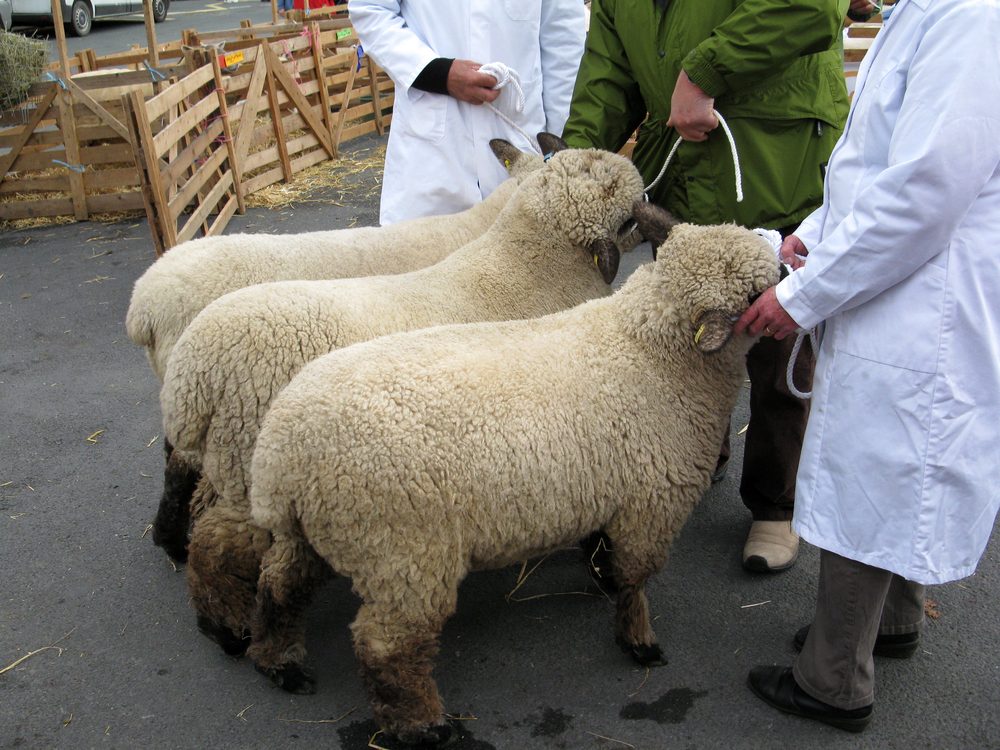
It is a large, powerful sheep with a dark head and a heavy fleece; Wikipedia describes it as the largest of the Down breeds.[8] The body is deep, long and symmetrical, with a broad, level back and strong bone; the standard speaks of a “blocky” appearance.[2][5]
Dark face, topknot and no horns
Rams and ewes are polled; small residual horn stumps (scurs) are considered a fault.[2][6]
Face colour changes with the source. The British standard asks for a face, ears and legs of dark or very dark chocolate brown, “not truly black”;[2][5] Wikipedia mentions brown or black wool on the face and legs;[8] and the American standard allows steel gray to dark (chocolate) brown, with no suggestion of black.[9] The AOSA adds that Oxfords imported before 1900 were nearly black, and OSU notes a lack of uniformity in colour markings.[10][7] So the colour can range from dark brown to almost black depending on the animal.
A woolly topknot on the poll is characteristic, a white spot on the nose is common, and wool blindness should be avoided.[2][6] The skin is pink, “cherry pink” in the British standard.[5][9]
Wool
The Oxford Down produces the heaviest fleece of the Down breeds: a long-staple, light-shrinking wool used for hosiery, knitting yarns and felts.[3][7] The figures change with the source and the production system:
| Source | Fleece | Staple length | Fineness |
|---|---|---|---|
| UK breeders’ association[3] | 3.5-4.5 kg | 10-13 cm | Bradford Count 54-56 |
| RBST[6] | 3-4 kg | 10-15 cm | Quality 50s-54s |
| OSU (mature ewes)[7] | 3.6-5.4 kg (8-12 lb) | 7.5-12.5 cm | 30.0-34.5 microns; count 46-50; yield 50-62% |
| AOSA[9] | 10-12 lb per year | — | — |
Oxford Down sheep weight
The UK association presents it as the heaviest of the Down breeds and the second heaviest of all British breeds; OSU says only the Lincoln surpasses it in body weight.[3][7] Adult weight varies with the source, the standard and the production system, so it is best read as a range per source rather than a single value:
| Source | Rams | Ewes |
|---|---|---|
| Wikipedia[8] | 110-145 kg | 90-110 kg |
| RBST[6] | 120-140 kg | around 90 kg |
| OSU[7] | 90-135 kg (200-300 lb) | 68-90 kg (150-200 lb) |
| British standard[5] | over 150 kg (typical) | over 100 kg (typical) |
| American standard[9] | over 250 lb (mature, in good condition) | over 200 lb (mature, in good condition) |
The UK association also reports an average breed weight of 100 kg (mature rams and ewes) and 92.1 kg for ewes at tupping in recorded flocks.[3] DAD-IS, quoted by Wikipedia, records a height of 86 cm for males and 76 cm for females.[8]
Oxford Down sheep breeding
The RBST reports typical lambing percentages of 150-160%, OSU says 150% is not uncommon, and in recorded UK flocks the association reports 1.76 lambs born per ewe lambed.[6][7][3] These figures come from different origins and years: use them as a reference, not a target.
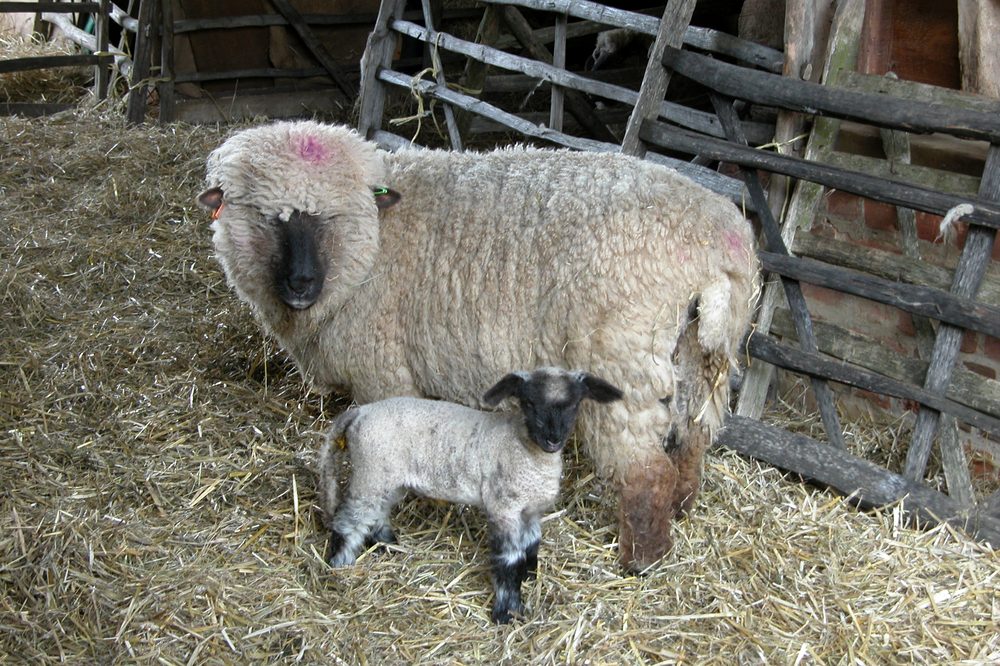
Ewes are docile with good mothering ability; lambing is relatively easy and many ewes lamb unassisted, partly because of the size of the breed, although the American standard warns that shoulders bred too wide can make it difficult.[3][9] Ewes take the ram early in the season, which suits early lamb production.[3] Lambs are large and strong at birth, with good wool cover and a strong instinct to suckle, and most ewes nurse twins without trouble.[7][6][3] The UK association gives these pure-bred lamb weights at 8 weeks:[3]
- Singles: males 26.3 kg; females 24.5 kg.
- Twins: males 20.0 kg; females 18.6 kg.
The RBST gives a general reference of about 22.4 kg at the same age.[6] For replacements, the association recommends selecting for growth, milkiness, prolificacy and mothering ability.[2]
Meat production with the Oxford Down
It is used mainly for meat and as a terminal sire.[8][4] According to the UK association, Oxford cross lambs typically produce 18-22 kg carcases at 12-16 weeks and 22-25 kg carcases at 9 months without excess fat;[4] the RBST gives 18-22 kg deadweight at 3-4 months.[6] The association also claims that its lambs mature up to 3 weeks earlier than lambs by other popular terminal sires.[4] These are figures and claims from the breeders’ own association, not from an independent trial.
It finishes well off grass or cheap fodder and stays lean at heavy weights.[4] OSU describes it as a very good feeder, suited to fertile farms with good feeding, but less inclined than the smaller Down breeds to get by on scanty vegetation.[7]
The meat is described as firm, lean and of excellent quality;[2] the RBST adds that it is well-marbled, tender and flavoursome.[6] The joints are large with plenty of lean meat, aimed at the home freezer trade, private butchers and farmers’ markets.[3] In high-input systems, body condition must be managed to avoid overfat lambs.[6]
What to check before using it in Uruguay or Argentina
We found no Oxford Down trials in Uruguay or Argentina (our own search, November 2026), and results from the United Kingdom and the United States may not transfer as they are. A review of Uruguayan work on sheep meat mentions Hampshire, Southdown, Poll Dorset, Suffolk and Milchschaf, but not Oxford Down.[15] Before using an Oxford ram, test it in your own flock and record weights, lambings and body condition.
Crossbreeding with the Oxford Down
The Oxford ram is used as a terminal sire on any commercial ewe breed or cross, and its lambs stand out for fast growth and vigour at birth.[4] The association documents its use on Blackface, Cheviot, Welsh Mountain, Swaledale, Dalesbred, Shetland and Whitefaced Woodland ewes: on hill ewes it adds size and weight, and the crossbred lamb is dark-faced.[4]
OSU agrees that Oxford rams are useful on small ewes to increase the weight and size of the lambs. Retained crossbred ewes (Oxford × Mule, Masham, Texel, Beltex or Charollais) have a wide pelvis, easy lambing, hardiness and hard feet.[7][4]
If you are looking for other meat options, see the comparison of 7 breeds of meat production sheep. For a contrast with a black-headed breed with little wool, there is the Dorper sheep page.
Oxford Down sheep management
According to the RBST, it adapts to lowland and upland grazing and suits extensive systems; the breeders’ association says it thrives in every climate, which is best taken as a claim by an interested party.[6][3] It is docile, but its size and strength call for firm handling.[6]
The feet are hard and need minimal attention.[3] When buying breeding stock, the association advises never buying unseen, judging each animal on its own merits and not just its paperwork, and checking feet, teeth that match the stated age, sound legs, two equal testicles in rams and healthy udders in ewes.[5]
To track weights, lambings, body condition and replacements, OvinApp is a free app for keeping your flock records; it has a free plan for up to 20 animals.
Advantages and disadvantages of the Oxford Down breed
Advantages
- Large size and fast growth, with vigorous lambs at birth.[4]
- Heavy fleece, the heaviest of the Down breeds.[3]
- Docile, good mothering ability and hard feet.[6][3]
- A good terminal sire on small ewes.[7]
Disadvantages
- An at-risk breed in the UK, with about 1600 pedigree ewes put to the ram per year.[1][6]
- Little uniformity of type and colour.[7]
- Needs good feeding, copes less well with scanty pasture and can produce overfat lambs.[7][6]
- Size that calls for firm handling and broad shoulders that can make lambing difficult.[6][9]
- No trials available in Uruguay or Argentina.
How to tell the Oxford Down from the Hampshire Down and the Suffolk
All three have dark faces, but they differ in head, legs and size. The Oxford Down descends in part from the Hampshire Down, while the Suffolk is recognized by its black face and black legs free of wool.
| Oxford Down | Hampshire Down | Suffolk | |
|---|---|---|---|
| Face | Dark (chocolate) brown to almost black, depending on the source[2][8][9] | Brown or black[11]; practically free of wool from the eyes down[13] | Black[12] |
| Wool on head and legs | Topknot on the poll; woolless face; dark legs with wool[2][6] | Thick white wool over the upper face; unbroken wool cap from neck to forehead[11][13] | Face and legs free of wool[12] |
| Horns | Polled[6] | Polled[11] | Polled[12] |
| Adult weight | Rams 110-145 kg, ewes 90-110 kg (Wikipedia)[8]; other sources in the weight table | Males 120 kg, females 80 kg (average)[11] | Males 125 kg, females 88 kg[12] |
| Origin | Hampshire Down and Southdown ewes × Cotswold rams; Oxfordshire; 1830s[1][8] | British breed of the 19th century; Southdown crossed with local sheep of the Hampshire Downs[11] | Southdown rams × Norfolk Horn ewes[12][14] |
The Suffolk was at first called “Blackfaces”[12] and the Hampshire Down carries a wool cap from the neck over the forehead.[13] Even so, colour and wool cover vary between individuals, and only registration or pedigree confirms the breed.[5]
Do not confuse it with “cara mora”: in Uruguay that term refers to the Hampshire Down, and a “cordero Cara Mora” is the lamb from a cross with a Hampshire Down ram, not an Oxford.[16]
Frequently asked questions about the Oxford Down sheep
How much does an Oxford Down sheep weigh?
Where does the Oxford Down come from?
Does the Oxford Down have horns?
Is the Oxford Down good for meat?
What is the difference between the Oxford Down and the Hampshire Down?
The Oxford descends in part from the Hampshire, but it is heavier and has a woolly topknot.[8][3] The Hampshire has a wool cap from neck to forehead.[13] More details on the Hampshire Down page.
Is the Oxford Down the same as “cara mora”?
No. In Uruguay “cara mora” refers to the Hampshire Down, not the Oxford Down.[16]
Sources
- Oxford Down Sheep Breeders’ Association (UK): history
- Oxford Down Sheep Breeders’ Association (UK): description
- Oxford Down Sheep Breeders’ Association (UK): the pure-bred Oxford Down
- Oxford Down Sheep Breeders’ Association (UK): commercial use
- Oxford Down Sheep Breeders’ Association (UK): starting a new flock and breed standard
- Rare Breeds Survival Trust (RBST): Oxford Down
- Oklahoma State University, Breeds of Livestock: Oxford Sheep
- Wikipedia: Oxford Down
- American Oxford Sheep Association (AOSA): breed standard
- American Oxford Sheep Association (AOSA): breed history
- Wikipedia: Hampshire Down
- Wikipedia: Suffolk sheep
- OSU: Hampshire Sheep
- OSU: Suffolk Sheep
- Bianchi, G.: What type of lamb should Uruguay produce? (produccion-animal.com.ar, in Spanish)
- Tardáguila: Bamidal and Hampshire Down slaughter agreement («Cara Mora» lamb, in Spanish)
Image credits
- Oxford Down sheep at the Chiltern Open Air Museum. Photo: Mike Peel / Wikimedia Commons, CC BY-SA 4.0. Cropped and color-adjusted.
- Oxford Down ewe with her lamb at the Chiltern Open Air Museum. Photo: Dorothea Witter-Rieder / Wikimedia Commons, public domain. Resized.
- Oxford Down sheep being judged at Masham Sheep Fair 2010. Photo: Jane Cooper Orkney / Wikimedia Commons, CC BY-SA 4.0. Resized.
The figures come from the sources cited, have different origins, standards and production systems, and may vary between flocks. Always consult your veterinarian or technician before deciding on a crossbreeding plan.