

Las 3 Enfermedades más Mortales en el Ganado Ovino: Guía de Identificación y Control
abril 22, 2026
Goodbye to Soy? 5 Secrets to Multiply Your Sheep Business Profitability
abril 29, 2026
In the technical management of sheep farms, profitability is not a product of chance, but the result of constant and rigorous health surveillance. As biosecurity consultants, we must understand that animal health is the foundation of productive efficiency. Infectious diseases not only cause significant direct losses through mortality, but also decimate return on investment through abortions, reproductive failures, and a drastic decrease in weight gain.
The economic impact is tangible: it is estimated that a producer can lose up to 15% of their lambs from enterotoxemia and up to 25% of herd productivity due to internal parasites if prevention protocols are omitted. Therefore, this technical guide addresses the three most devastating pathologies for the sector: Enterotoxemia, Peste des Petits Ruminants (PPR), and Bluetongue. The transition from curative to preventive medicine is the only way to guarantee agricultural sustainability.
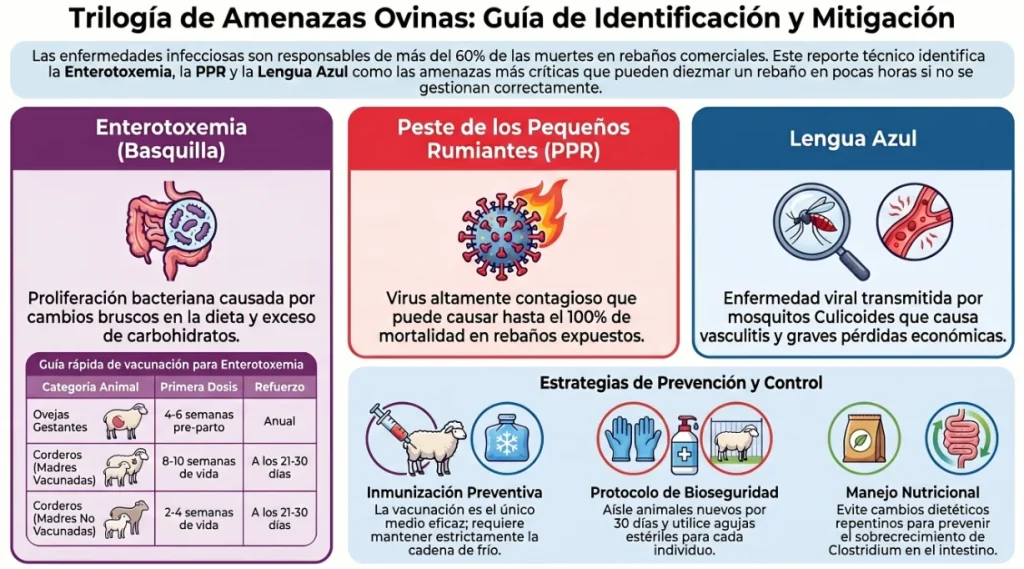
Enterotoxemia (Overeating Disease, Pulpy Kidney)
Cause and Pathogenesis
Enterotoxemia is an acute infectious disease caused by toxins from the bacterium Clostridium perfringens, predominantly types C and D. These bacteria are common commensals of the digestive tract, but their explosive proliferation is triggered by management factors, especially ruminal acidosis caused by abrupt dietary changes or an overload of starch-rich grain. Undigested starches pass into the intestine, providing a substrate for the clostridium to release potent toxins that penetrate the bloodstream, causing lethal systemic damage.
Symptoms and Clinical Findings
The course of the disease is frequently hyperacute. Critical clinical signs include:
- Sudden death in animals that appeared healthy (especially feedlot lambs).
- Sudden loss of appetite and profound depression.
- Arching of the back and kicking at the belly, indicative of marked abdominal discomfort.
- Hemorrhagic watery diarrhea and extreme weakness.
- At necropsy, the sign of pulpy kidney (rapid renal autolysis) and hemorrhages in the small intestine are observed.
Prevention and Expert Management
It is imperative that the producer understands that there is no effective treatment once acute symptoms appear; the clinical success rate is practically zero.
- Vaccination Protocol: Administer the first dose to lambs between 4 and 6 weeks of age, with an essential booster 2 to 4 weeks later. In adults, annual revaccination is required, preferably 4–6 weeks before parturition to maximize passive immunity through colostrum.
- Biological Management: Vaccines must be strictly kept between 2°C and 8°C (36°F–40°F). It is essential to avoid the use of chemical sterilants to disinfect syringes when using modified live virus (MLV) vaccines, as they would inactivate the product.
- Application Hygiene: A sterile needle per animal must be used to prevent iatrogenic transmission of pathogens, and never reinsert a used needle into the vaccine vial once opened.
Peste des Petits Ruminants (PPR)
Cause and Pathogenesis
PPR is caused by a virus of the genus Morbillivirus (family Paramyxoviridae), closely related to rinderpest. The entry route is primarily respiratory (aerosols) or oral. The virus has a marked tropism for lymphoid tissue and epithelial cells, causing lymphoid depletion and severe immunosuppression. A crucial epidemiological detail for the consultant is that cattle may present subclinical infections; however, bovines are not transmitters of the virus to small ruminants.
Symptoms and Pathological Lesions
PPR manifests with a morbidity reaching 100%. Key terms include:
- High fever and severe depression.
- Necrosis and erosions in the oral mucosa and pharynx, without vesicles.
- Foul-smelling mucopurulent nasal discharge that can block the nasal passages.
- At necropsy, the pathognomonic findings are «zebra colon» (longitudinal congestion), tracheitis, and severe fibrinous-ulcerative enterocolitis.
Prevention and Control
Treatment is strictly supportive. Vaccination is the cornerstone for achieving the goal of global eradication by 2030. Being a transboundary disease of high impact, its notification to health authorities (WOAH) is mandatory and immediate upon any suspicion.
Bluetongue (Ovine Catarrhal Fever)
Cause and Pathogenesis
It is a non-contagious viral disease caused by an Orbivirus and transmitted exclusively by midges of the genus Culicoides. These insects are the only significant natural transmitters. The virus replicates in vascular endothelial cells, resulting in edema, hemorrhages, and tissue necrosis from vascular occlusion. Species such as C. sonorensis or C. imicola are classic vectors, but the northward geographic expansion of the disease is due to the adaptation of new species like C. dewulfi.
Symptoms and Clinical Diagnosis
- Fever and excessive salivation.
- Edema of the face, ears, and tongue.
- Cyanotic tongue (bluish coloration) that may protrude from the mouth.
- Pathognomonic lesion: Inflammation of the coronary band showing a purple-red band at the junction with the hoof, causing severe lameness.
- Wool loss in survivors due to focal dermatitis.
Prevention and Treatment
- Vector Control: Eliminate standing water, use insecticides/repellents, and implement nighttime housing, as Culicoides are most active during dusk and night.
- Specific Vaccination: There is no cross-immunity between the 29 known serotypes. Annual vaccination should be done before the onset of vector activity (April–May).
- Supportive Care: Provision of soft food and rest in shaded areas.
Comparative Disease Chart
Pillars of Biosecurity and Comprehensive Prevention
To safeguard the farm, strict protocols must be implemented:
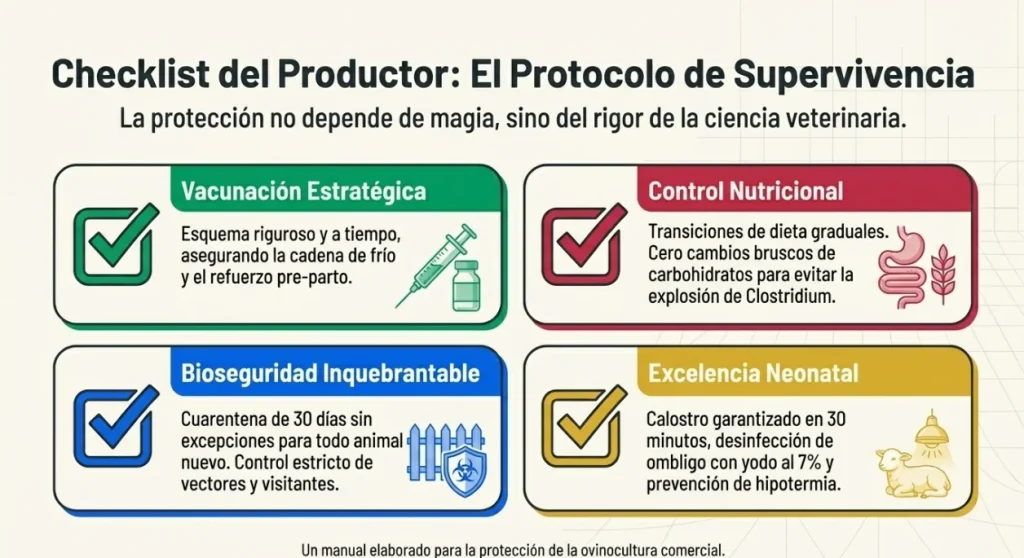
- Quarantine and Isolation: Quarantine (new animals or those returning from fairs) must last 21 to 30 days in a separate area to prevent the introduction of pathogens. Isolation is reserved exclusively for already sick animals, who must always be attended to last during the workday.
- Rigorous Hygiene: Use potent disinfectants such as bleach (1/2 cup per gallon of water). The one needle per animal rule must be implemented; the use of contaminated instruments is a proven mechanical transmission route for Orbivirus.
- Colostrum Management: Newborns must ingest 10% of their body weight in colostrum within the first 24 hours. This is vital because, after this period, the intestinal epithelium matures and becomes impermeable to large antibody molecules, closing the window of passive immunity.
- Feeding: Never feed animals directly on the ground. The use of clean feeders and waterers prevents the oral transmission route of clostridia and other pathogens.
Conclusion and Expert Recommendations
Sheep health is a strategic investment, not an operational cost. Implementing rigorous vaccination programs, always respecting the cold chain (2–8°C) and aseptic application techniques, is the most powerful tool to ensure productivity. Preventive medicine surpasses any curative intervention in profitability, especially against highly pathogenic viruses like PPR or fulminant toxemias.
As a final recommendation, it is imperative to consult with a specialist veterinarian before initiating any health plan and to maintain detailed records of batches and application dates. Traceability and biosecurity are the only guarantors of food safety and business success.