

The 3 Most Deadly Diseases in Sheep: Identification and Control Guide
abril 29, 2026
Beyond the Pasture: 8 Surprising (and Vital) Truths About Sheep and Goat Feeding
abril 29, 2026
In today’s agribusiness landscape, one assertion is gaining ground among forward-thinking farm managers: under a specialized management scheme, sheep farming can exceed the profitability of traditional crops like soy or corn. What was historically considered a subsistence or complementary activity now stands as a high-precision financial investment architecture, capable of delivering return on investment (ROI) that is highly competitive.
The success of this model does not depend on tradition, but on strategic genetic planning. Breed selection has ceased to be an aesthetic preference and has become a critical cash flow decision; it is the difference between an asset that generates steady dividends and an operational liability. In a global market driven by insatiable demand for red meat and premium fibers, understanding each animal’s biological capabilities is the key to maximizing margins.
Below, we analyze the technical and market revelations redefining the sector. From optimizing operating costs (OPEX) to accessing ultra-luxury markets, discover why diversification into the «woolly giant» is the most solid growth strategy for the modern farm operation.
1. The End of Shearing Tyranny: The Hair Revolution
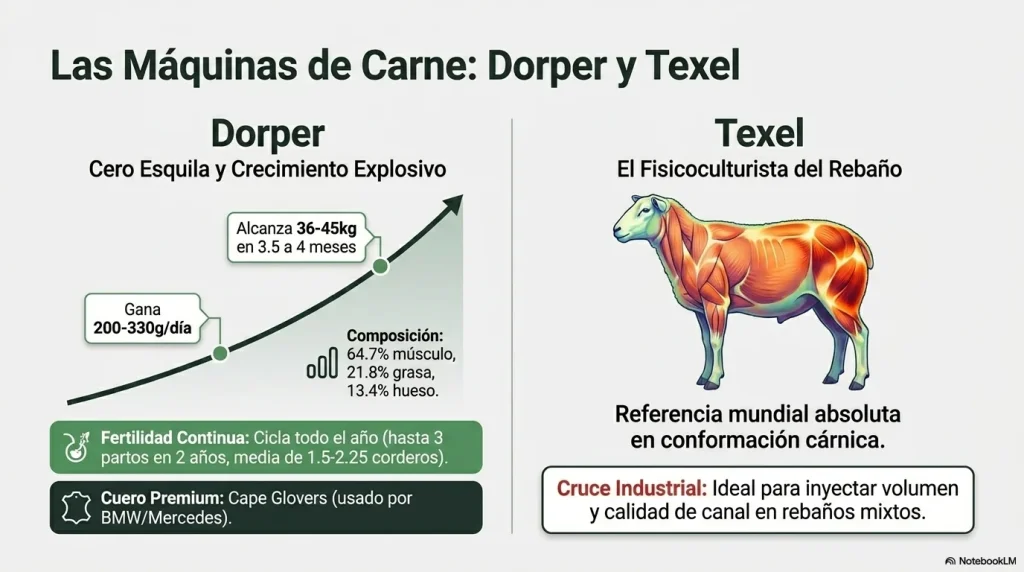
The emergence of the Dorper breed has shattered the traditional cost structure by mitigating dependence on specialized labor. Being a hair sheep, the animal undergoes natural shedding, completely eliminating the operational shearing expense—a cost item that today represents financial volatility for many producers. This competitive advantage drastically reduces OPEX and, in parallel, decreases the incidence of myiasis (blowfly strike), simplifying health management and animal stress.
From a performance perspective, the Dorper is a high-efficiency «conversion unit.» It possesses outstanding carcass composition with 64.7% muscle, 21.8% fat, and only 13.4% bone. Moreover, its added value extends to the luxury industry: its leather, marketed under the Cape Glovers brand, is a quality standard such that giants like BMW and Mercedes-Benz use it in their premium upholstery and accessories.
«Natural hair shedding in the Dorper breed eliminates the extremely high cost of shearing and avoids critical health problems, radically transforming the farm’s operational cost structure.»
2. The «Bodybuilder» Efficient: Texel and Ecological Conversion
Originating in Holland, the Texel breed has established itself as the global benchmark for meat conformation and biological efficiency. Its ability to achieve carcass yields exceeding 60% places it at the pinnacle of per-hook productivity. Nevertheless, its greatest revelation for the modern strategist is its capacity to reduce feeding costs without sacrificing growth.
INIA studies have confirmed that highly efficient Texel lines exist capable of producing the same output while consuming 24% less feed. This optimization of the feed conversion ratio not only directly impacts net margin but positions the breed as an «ecological» option by reducing methane gas emissions per kilogram produced—a determining factor for accessing international markets with strict sustainability regulations.
3. The «Master Formula»: Industrial Crossbreeding and Hybrid Vigor
Maximum profitability does not necessarily reside in breed purity, but in the exploitation of heterosis. Industrial crossing—using a rustic maternal base with a high meat aptitude sire like Suffolk or Texel—is the fastest strategy to increase meat production by 30% to 50%.
Quantitative benefits of hybrid vigor:
- Increased birth weight: Additional gains of 400g to 1kg per lamb.
- Accelerated daily growth: Increases in weight gain rate of 10% to 30%.
- Temporal competitive advantage: Ability to reach lamb carcasses of 14 to 16 kg in a window of just 100 days.
- Reduced mortality: Superior vitality of hybrids ensures a greater number of lambs for sale.
Under this scheme, what the industry calls asset optimization is achieved: «Keeping rustic breeds means having ‘economical breeding ewes'», allowing production of premium proteins on dams with minimal maintenance costs.
4. The «White Gold» Dilemma: Why 21 Microns Are the Frontier of Success
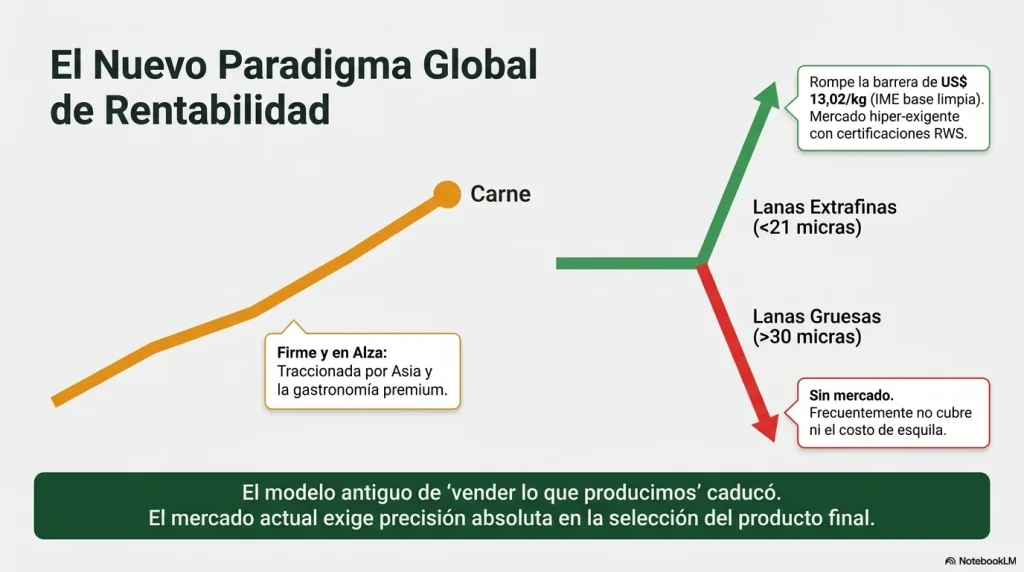
The wool market is undergoing historic polarization driven by selective demand. Today, financial success is delimited by fiber diameter. The Eastern Market Indicator (IME) recently exceeded US$13.02 per kilogram clean basis, but this price is a privilege of fine wools.
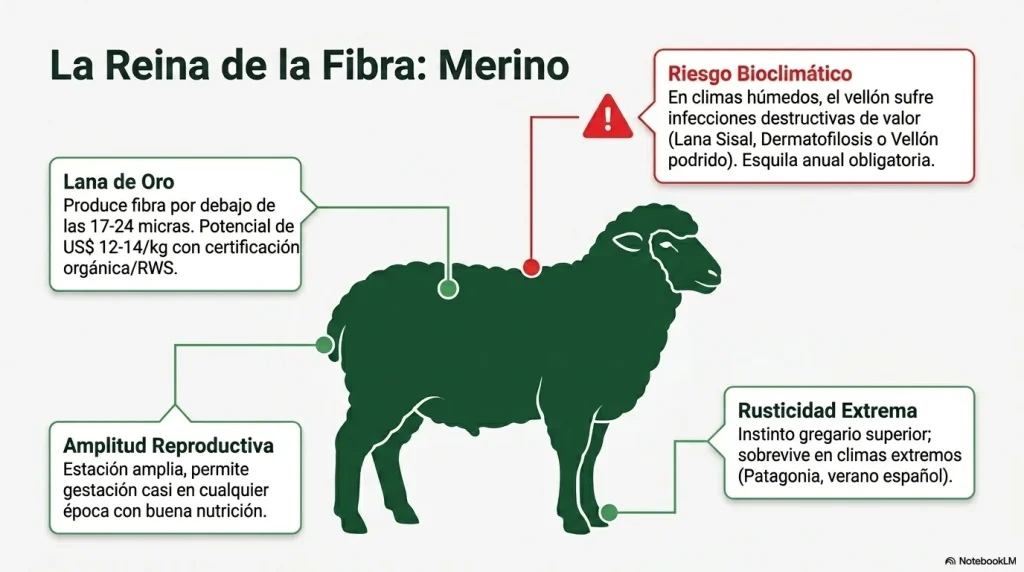
While coarse wools over 30 microns have become a burden often not covering collection costs, ultrafine wools from the Merino breed (18 to 21 micron segment) reach record prices. The winning strategy today demands not only Merino genetics but backing from certifications like RWS (Responsible Wool Standard) or organic to capture maximum value in global fashion houses.
5. Breaking the Calendar: Fertility Without Seasons
One of the greatest historical bottlenecks in sheep farming has been seasonality. However, breeds like Dorper and Early Merino offer a unique seasonal competitive advantage: the ability to cycle year-round, enabling schemes of up to 3 lambings in 2 years.
This deseasonal ization allows scheduling births so that market exit coincides with the highest demand and maximum price window (October to December). To correct lower sexual activity in some sires during spring, genetic selection and the use of breeds like Ile de France have proven to be the ideal technical solution, guaranteeing active and fertile sires even during the most challenging times of the breeding calendar.
OvinApp is comprehensive sheep control and management software that lets you professionalize your flock management directly from your phone. With this free application for your first 10 animals, you can maintain detailed clinical and production records including matings, births, feeding, and health treatments with preventive alerts.

Plus, OvinApp automatically calculates your reproductive indices (such as fertility, lambing percentage, and prolificacy), generates financial reports of income and expenses, and includes a community alert system to report theft or predator attacks in your area. It’s the ideal digital tool to organize your field tasks and make better decisions for your business profitability.
The Profitability Verdict
There is no absolutely «better breed,» but an optimal genetic strategy for each ecosystem and financial objective. The numbers speak eloquently: a lot of 100 Merino sheep with certified fine wool can generate around US$11,000 gross, while a herd of 100 well-managed Texel aimed at premium carcasses can reach between US$28,000 and US$30,000 gross, though requiring a more intensive feed cost structure.
The verdict is clear: sheep profitability is today more stable than grain markets for those who know how to diagnose their environment:
- In arid climates and large tracts: Merino with ultrafine wool.
- In high-quality pasture systems: Texel as terminal sire.
- To minimize operating costs and rapid turnover in warm climates: Dorper.
In a world demanding efficient, traceable proteins and sustainable fibers, the question for the modern producer is inescapable: Is your farm maximizing the potential of modern genetics to maximize your cash flow?