


Goodbye to Soy? 5 Secrets to Multiply Your Sheep Business Profitability
abril 29, 2026
Highlander Sheep Breed: Innovation in Efficiency and Profitability for Sheep Production
abril 29, 2026
1. The Modern Producer’s Dilemma: Science vs. Intuition
For the traditional producer, feeding often reduces to a simple premise: «if there’s pasture, there’s food.» However, from the perspective of technified livestock management, this approach is the primary limiter of profitability. As a Senior Specialist, I maintain that if herd management could be reduced to a single primary principle, it would be nutrition.
A sheep or goat under optimal nutritional planes not only maximizes its genetic potential but maintains a homeostasis that allows it to better resist parasitic and immunological challenges. Today, the difference between costly «survival» and efficient production lies in data. Digital tools like OvinApp allow these scientific truths to translate into measurable results, transforming intuition into professional management of daily weight gain and conversion efficiency.
2. Copper: The Silent Killer and the Mineral Paradox
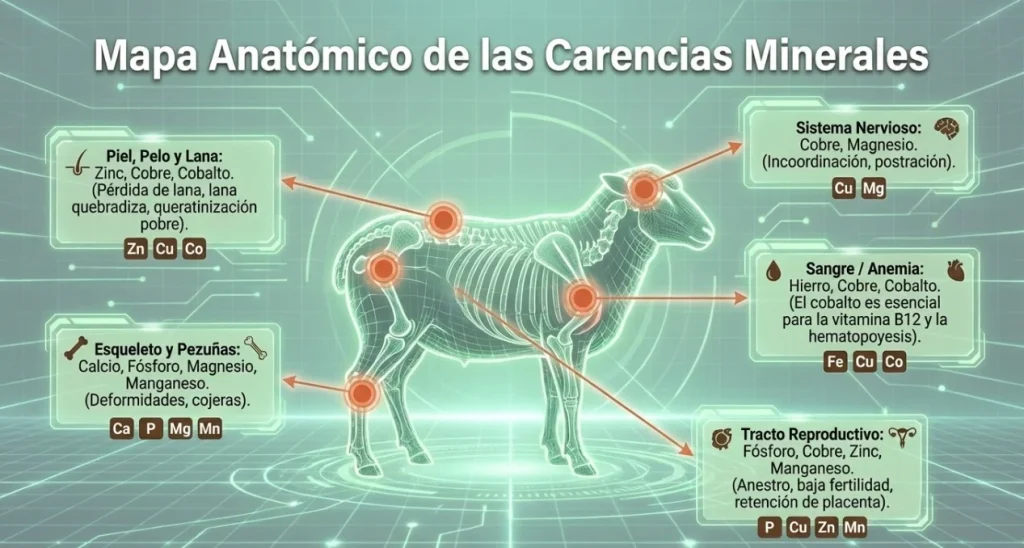
Copper is indispensable for myelination of nerves; its deficiency causes Enzootic Ataxia (Swayback). However, in sheep, the line between necessity and death is extremely thin.
Sheep are exceptionally sensitive and accumulate copper in the liver silently. The real danger occurs when a stress factor or illness acts as a «trigger,» causing sudden release of the mineral into the blood, triggering a fatal hemolytic crisis.
- The unbreakable limit: Any mineral mix formulated for sheep should not exceed 30 ppm of copper.
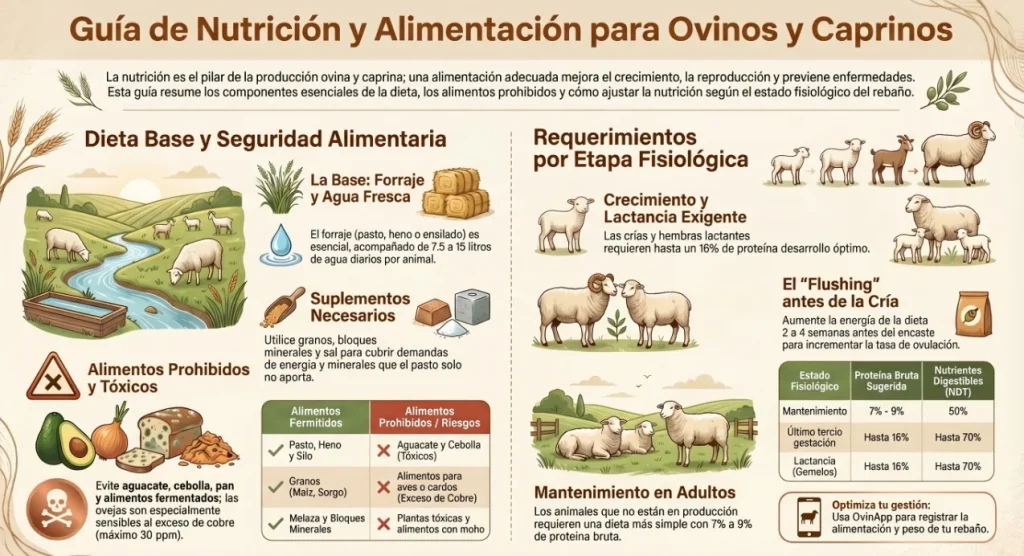
- ⚠️ CRITICAL WARNING: Never feed sheep «farm sweepings» or swine or poultry feed. The latter can contain up to 700 ppm of copper, lethal doses that saturate the liver in record time.
«Copper deficiency manifests visually in ‘steely’ wool. It loses its characteristic crimp, becoming lank and silky, which destroys its commercial value in the textile market.»
3. The Grain Danger: Anatomy, Urolithiasis, and Mineral Balance
Urolithiasis (urinary calculi) is a constant threat to males. While females possess a short, straight urethra, the ram’s anatomy presents two critical «traps»: the vermiform appendage and the sigmoid flexure, where sediments often impact causing anuria and stranguria.
The trigger is almost always an imbalanced Calcium:Phosphorus (Ca:P) ratio caused by excess grain (rich in phosphorus).
- The Golden Rule: The diet must maintain a Ca:P ratio of 2:1.
- Specialist Strategy: Beyond promoting water consumption and exercise to increase urinary output, in intensive systems it is vital to use Ammonium Chloride as a urinary acidifier to prevent phosphate crystal formation.
4. The «Fat Sheep» Paradox: Toxemia and Energy Metabolism
Pregnancy Toxemia is not exclusive to undernourished animals. In fact, sheep with excessive body condition (obese) face the greatest metabolic risk. This condition is a critical combination of hypoglycemia and hyperketemia caused by a negative energy balance.
In the final third of pregnancy, rumen space decreases drastically due to fetal growth, while energy demand skyrockets. In fat ewes, massive mobilization of fat reserves saturates the liver, generating toxic ketone bodies.
- Digital Management: Use OvinApp to record and filter animals by their Body Condition Score (BCS). Identifying ewes with BCS > 4.0 before lambing allows you to adjust diet and prevent uncontrolled fat mobilization.
5. Water: The Forgotten Mineral Vehicle
A 50 kg sheep consumes between 7.5 and 15 liters of water per day at maintenance. However, this volume is only part of the equation. Water is a vehicle of minerals and its salinity must be evaluated rigorously.
High salt or magnesium concentrations in water can interfere with the overall mineral program, predisposing the animal to metabolic imbalances. Consumption fluctuates not only from heat but from physiological status; a lactating female can double her water requirement to maintain milk production.
6. «Flushing»: Optimizing Prolificacy with Precision
Flushing is an increase in dietary energy density 2 to 4 weeks before reproduction to stimulate ovulation rate.
While New Zealand studies cite increases of up to 25% in ovulation rate by offering significant energy supplementation, a specialist knows that this nutritional «hack» is an investment, not a generalized expense.
- Cost strategy: Flushing has real return on investment only in thin animals (BCS < 3.0). Use OvinApp historical records to segment the herd and apply supplementation only to females who need it, optimizing feed costs without wasting resources on animals already at their optimal weight.
7. The 10% Rule: The Lamb’s Immunological Shield
Colostrum is life. Because there is no transplacental immune transfer, the newborn depends entirely on immunoglobulin ingestion in its first hours.
- The Exact Measure: Lambs must receive at least 10% of their body weight in high-quality colostrum during the first 24 hours.
- Gastrointestinal Stability: After colostrum, if artificial feeding is used, the milk source must be constant. Abrupt changes alter the developing ruminal microflora, predisposing neonates to fatal enterotoxemias.
8. Forbidden Foods: The Collapse of Ruminal Ecosystem
The rumen is a delicate fermentation chamber. Certain foods cause a sharp drop in ruminal pH, destroying the bacteria responsible for fermenting fiber and causing lactic acidosis that irreversibly damages the GI tract lining.
Strictly avoid in the feeders:
- Avocado and Onion: Metabolic toxins for small ruminants.
- Bread and simple sugars: Immediate triggers of acidosis and bloat.
- Moldy fermented feeds: Source of mycotoxins causing abortions and sudden deaths.
- Local toxic plants: Browsing unidentified species is a sanitary game of Russian roulette.

Conclusion: From Guesswork to Professional Management
Nutrition represents the highest operational cost (up to 60–70%), but is also the variable with the greatest impact on profitability. Moving from «guesswork» to professional management requires that every gram of feed be recorded and contrasted with productive performance.
Recording feeding history, BCS changes, and weight gains in OvinApp allows the technified producer to identify inefficiencies before they become clinical losses. As a producer, the choice is yours: Are you feeding your animals just to survive, or to reach the maximum of their genetic potential?