

Purity Grades in Sheep and Goats: Fractions, Upgrading, and Registry
November 19, 2026Sheep Reproduction: Estrous Cycle, Fertility, and Probable Lambing Date
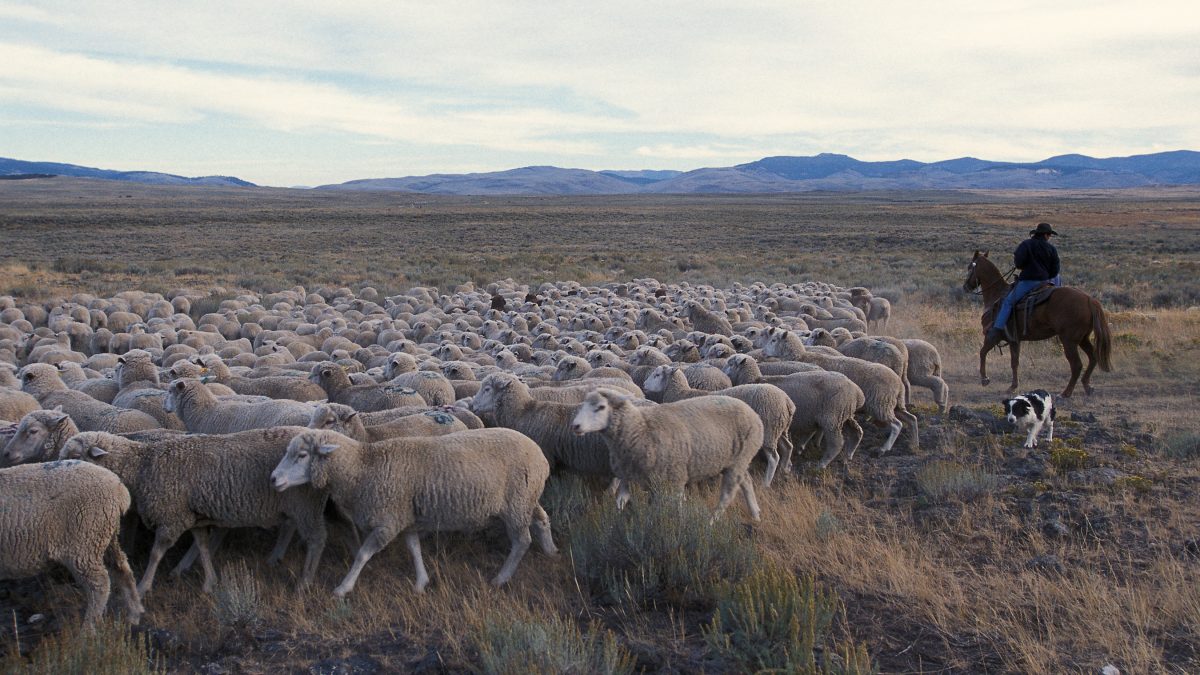
Stephen Ausmus, Agricultural Research Service (USDA). Public domain. Wikimedia Commons, File:Grazing_Idaho_sheep.jpg.
A ewe’s gestation lasts about 150 days, and a doe’s gestation also averages about 150 days. The Merck Veterinary Manual lists 150 days for both species in its table of approximate gestation periods. In more detail, Merck describes a normal gestation of 144 to 150 days in sheep and 145 to 155 days in goats, with an average of 150. Below you will find a calculator that uses those ranges to estimate the probable lambing or kidding date and the window in which it may occur, whether you enter a single service date or the start and end of a breeding period.
Probable lambing date calculator
Calculator
Expected lambing or kidding date
Choose the species and enter the service (breeding) date, or the start and end of the breeding period. The tool estimates the due date and the lambing or kidding window using Merck Veterinary Manual ranges.
Enter the details to see the expected date, the birth window, days elapsed and days remaining.
Source: Merck Veterinary Manual gestation table (150 days); sheep 144–150 days and goats 145–155 days (average 150). This is an estimate, not a diagnosis.
The tool has two modes, and the right one depends on the information you have. In service date mode, you enter the day of a directed mating or an insemination. The calculator adds 150 days to show the probable date, and it also builds the window: 144 to 150 days after service in sheep, or 145 to 155 days after service in goats. It shows how many days have passed since service and how many remain until the probable date, with the window as a reference.
In breeding period mode, you enter the start and end of the service period. The logic changes: the lambing or kidding window runs from the start of the period plus the minimum gestation length to the end of the period plus the maximum. The reference probable date is the midpoint of the breeding period plus 150 days. This is practical when ewes or does run with the male for several weeks and there is no exact service day.
On that point, Merck notes that the exact date of conception is rarely known unless there has been directed mating or insemination. When ewes run with the ram and are marked with a raddle or crayon at 14- to 17-day intervals, the lambing date is calculated within a 14- to 17-day period. The calculator’s window reflects that uncertainty, but it does not remove it: it is an estimate, not a diagnosis, and it does not replace ultrasound or the veterinarian’s assessment.
Gestation ranges according to Merck
Merck summarizes approximate gestation periods in a quick-reference table. For sheep and goats, the values are shown below.
Reference ranges
Gestation length according to Merck
The calculator uses these ranges. Some breeds may differ slightly, which is why the result is shown as an expected date and a window.
| Species | Reference value | Window | Source |
|---|---|---|---|
| Sheep | 150 days | 144–150 days | Merck Veterinary Manual |
| Goat | 150 days (average) | 145–155 days | Merck Veterinary Manual |
Seasonality and photoperiod
In temperate latitudes, reproductive activity in many sheep breeds increases with short days, that is, toward autumn and winter. Near the equator, the difference between seasons is often smaller, and some flocks breed throughout the year. Breed modulates that response strongly: some lines are more seasonal and others cycle more openly. The original article mentions Texel, Suffolk, Poll Dorset, and Hampshire as examples along that spectrum. Understanding photoperiod helps plan the breeding period and interpret results. It is not the same to aim for service during deep seasonal anestrus as to use the window in which females are already cycling.
Nutrition and flushing
Nutrition is one of the factors that most influences fertility. Flushing means improving the nutritional offer before service so that females arrive in better body condition. It is used mainly in ewes that are thin or in systems with limited resources. Adequate body condition at mating is associated with better reproductive results than a female that reaches service in deficit.
It is also worth reviewing forage quality and availability, water access, and mineral supplementation. None of these factors acts alone: fertility is the result of nutrition, health, management, and genetics working together.
Stress
Stress reduces fertility, and in sheep the most common sources are rough handling, transport, dogs, heat, overcrowding, and abrupt feed changes. A breeding period in which animals are moved from paddock to paddock unnecessarily, or penned in inadequate facilities, usually pays a reproductive cost. The male’s stress counts too: a ram that arrives at service tired or injured will not perform the same.
Ram effect
Introducing rams to a group of females that are in anestrus can trigger ovarian activity and bring the onset of estrus forward. This is the ram effect, a useful and low-cost management tool, especially at the start of the season. It is not the same as a synchronization protocol: here we mention it as a natural stimulus.
Genetics and maturity
Genetics and age determine when a female enters production. According to Boletín INIA No. 3 (ISSN 0717-4829), Manual Ovino, females begin to cycle (puberty) between 5 and 10 months of age, and males produce sperm between 3 and 6 months. In more traditional systems, the first lambing is expected around 24 months. Under intensive mating, 7-month-old ewe lambs can be mated if they weigh more than 45 kg, or when they reach 60 to 75% of their dams’ weight.
In males, serving capacity also varies. A ram lamb can serve 35 to 50 ewes in the season; if conditions are not good, possible coverings drop to fewer than 20. That figure helps size how many sires a flock needs.
Estrous cycle and heat
The ewe’s estrous cycle averages 17 days, with a range of 14 to 20 days. Heat normally lasts 19 to 24 hours, and in extreme cases up to 36; in ewe lambs or first-time mothers it is shorter, 9 to 12 hours and sometimes less. Ovulation usually occurs about 24 to 30 hours after the onset of heat. These figures, also from Boletín INIA No. 3, explain why heat detection and service timing matter so much: a short window demands frequent observation.
From breeding date to lambing: getting organized
With the probable date or the lambing window, you can organize flock work: prepare for lambing, check facilities, adjust female nutrition, and coordinate assistance. In the final stretch of gestation, pay attention to energy balance, because pregnancy toxemia is a risk when females, especially those carrying more than one lamb, do not meet their requirements.
It also helps to compare results with the farm’s productive and reproductive parameters and to review sire selection with the guide to choosing a good sheep breeder. Flock health carries as much weight as the service date. If you work with Dorper, the breed page gives a range of 142 to 153 days, with an average of about 146 to 147 days; that figure comes from the breed page, not from Merck, so it is a breed reference, not a rule of the calculator, which uses only Merck’s ranges.
Frequently asked questions
How long is a sheep pregnant?
About 150 days. Merck lists 150 days in its table and describes a normal range of 144 to 150 days. Merck’s review of prolonged gestation in cattle and sheep is the reference for that range.
How long is a goat pregnant?
About 150 days on average. Merck gives a range of 145 to 155 days in its article on pregnancy in goats, with variation by breed, litter weight, environment, and parity.
Why does the calculator show a window instead of a single day when I enter a breeding period?
Because the service period covers several days and there is no exact conception date. The window runs from the start of the period plus the minimum gestation length to the end plus the maximum, and the reference date uses the midpoint plus 150 days.
Does the calculator work if I do not know the exact service day?
Yes, use breeding period mode. Merck also notes that when ewes are marked with a crayon at 14- to 17-day intervals, lambing is calculated within a 14- to 17-day period.
Do all breeds have the same gestation length?
No. Merck notes that in goats it varies by breed, litter weight, environment, and parity. In sheep, the Dorper page on this site gives 142 to 153 days, but that figure comes from the breed page, not from Merck; the calculator uses only Merck’s ranges.
Does the calculator replace an ultrasound or a veterinarian?
No. It is an estimate for organizing management, not a diagnosis. It does not replace ultrasound or the veterinarian’s assessment.
Final thoughts
Recording matings and births turns these estimates into useful information for the next season. In OvinApp you can log matings, services, and births, and see probable lambing and kidding dates for sheep and goats. The free plan covers up to 20 animals. Start on the sheep and goat app page or check the matings and births help center.