

Productive and Reproductive Parameters in Sheep: Key Reference Values
abril 6, 2026
Kiko Goat: Characteristics, Parasite Resistance and Meat Production
abril 6, 2026The Texel sheep is one of the most important and highly regarded meat breeds in Europe and increasingly worldwide. Developed on the Dutch island of Texel, this breed is prized for its exceptional lean, well-muscled carcass, making it a key breed in European lamb production and an increasingly popular choice for producers seeking superior carcass quality.
Origin and History
The Texel originated on the island of Texel, off the northern coast of the Netherlands, in the 19th century. It was developed by crossing local Dutch sheep with imported British breeds — primarily Lincoln and Leicester — to improve carcass muscling and meat quality. The breed was officially established in the Netherlands in the early 20th century and exported widely after World War II.
Today, the Texel is found in the UK (where it is the most popular terminal sire breed), France, Belgium, Germany, New Zealand, Australia, South Africa, Uruguay, Brazil and many other countries. The British Texel, developed since its importation in 1971, has become a somewhat distinct sub-population known for its extreme muscling.
Physical Characteristics
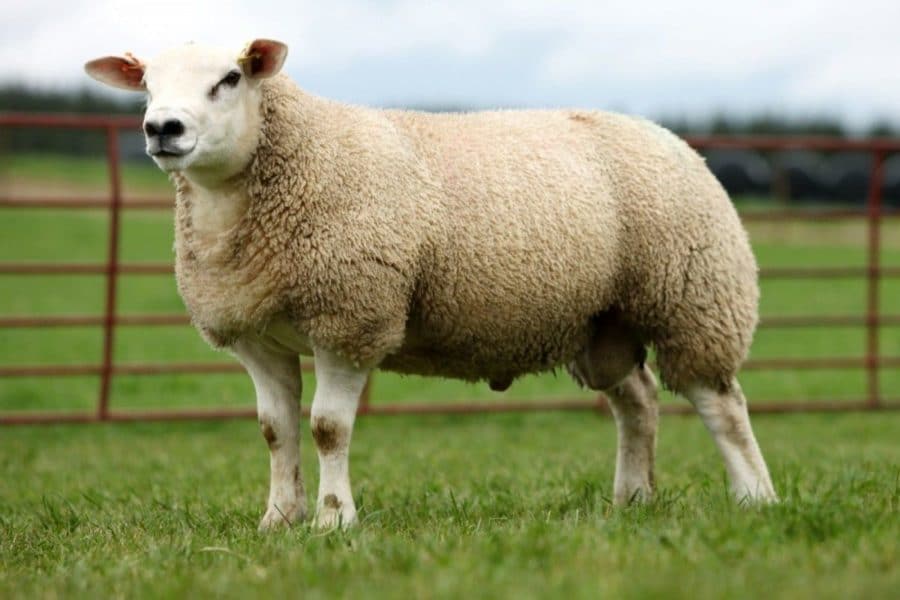
- Head: White, broad, slightly Roman-nosed, with a short muzzle. No wool on the head.
- Ears: Short, white, horizontally carried
- Body: Very wide, deep and heavily muscled — especially in the loin, back and gigot (leg)
- Fleece: White, dense, medium-fine (28–35 microns)
- Horns: Polled (both sexes)
- Legs: White, strong, well-spaced
- Adult ram weight: 85–130 kg
- Adult ewe weight: 65–90 kg
The Texel is immediately recognizable by its very wide, muscular body — particularly the exceptionally broad, flat back and heavily developed hindquarters. This extreme musculature is the breed’s defining trait and its main commercial advantage.
Meat Production: The Texel’s Main Advantage
The Texel’s greatest strength is its exceptional carcass quality:
- Lean meat percentage: Among the highest of any sheep breed — Texel carcasses have very high muscle:fat ratio
- Dressing percentage: 50–56%
- Average daily gain: 250–350 g/day (not the fastest grower, but very efficient muscle deposition)
- Slaughter weight: Lambs typically reach 38–50 kg at 4–6 months
- Leg and loin conformation: Exceptional — the breed consistently achieves top grades in European carcass classification systems (EUROP scale grade E or U)
The Texel does not deposit excessive fat even at heavier weights — a major advantage in markets that penalize overfat carcasses. This makes it ideal for producing heavy lambs without fat penalties.

Reproductive Characteristics
- Breeding season: Autumn in temperate climates (short-day breeder)
- Prolificacy: 130–165% — not the most prolific breed but twinning is common
- Gestation: 147–150 days
- Lamb birth weight: 4.5–6 kg (relatively heavy — ensure adequate pelvis size in ewe lambs at first lambing)
- Dystocia risk: Higher than average due to large, muscular lambs — monitor closely during lambing season
- Maternal ability: Adequate but not exceptional — ewes are usually good mothers
Texel as a Terminal Sire
The Texel is primarily used as a terminal sire — rams are crossed with maternal breed ewes to produce slaughter lambs. Key outcomes of Texel crossbreeding:
- Crossbred lambs show marked improvement in lean meat percentage vs. maternal breeds
- Excellent muscling of leg and loin is transmitted strongly to crossbred progeny
- Crossbred carcasses achieve higher market grades
- Particularly effective when crossed with fine wool breeds (Merino, Corriedale) that have lean, light-framed carcasses
In the UK, over 40% of all lambs slaughtered have Texel genetics — a testimony to the breed’s dominance in terminal sire roles.
Wool Production
The Texel also produces a useful fleece:
- Fleece weight: 3–5 kg per year
- Fiber diameter: 28–35 microns (medium grade)
- Staple length: 80–100 mm
- Used primarily for hand-spinning and niche markets
Adaptability and Health
The Texel adapts well to temperate climates. It performs best in cool, humid conditions and is naturally suited to northern European environments. In subtropical regions it can perform well but may require more careful management of internal parasites and heat stress.
Key health considerations:
- Spider syndrome (Spider Lamb Syndrome): A skeletal defect caused by a recessive gene. Carriers should be identified through genetic testing and excluded from breeding programs.
- Internal parasites: The Texel shows moderate susceptibility to Haemonchus — FAMACHA monitoring and targeted treatment are recommended.
- Dystocia: Large, heavily muscled lambs increase risk — cull ewes with narrow pelvises and monitor first-time ewes closely.
- Foot conditions: Regular hoof trimming and foot bathing recommended.
Tracking weight gains, health events and lambing records for your Texel flock in OvinApp allows you to maximize the breed’s genetic potential and make informed selection decisions over time.